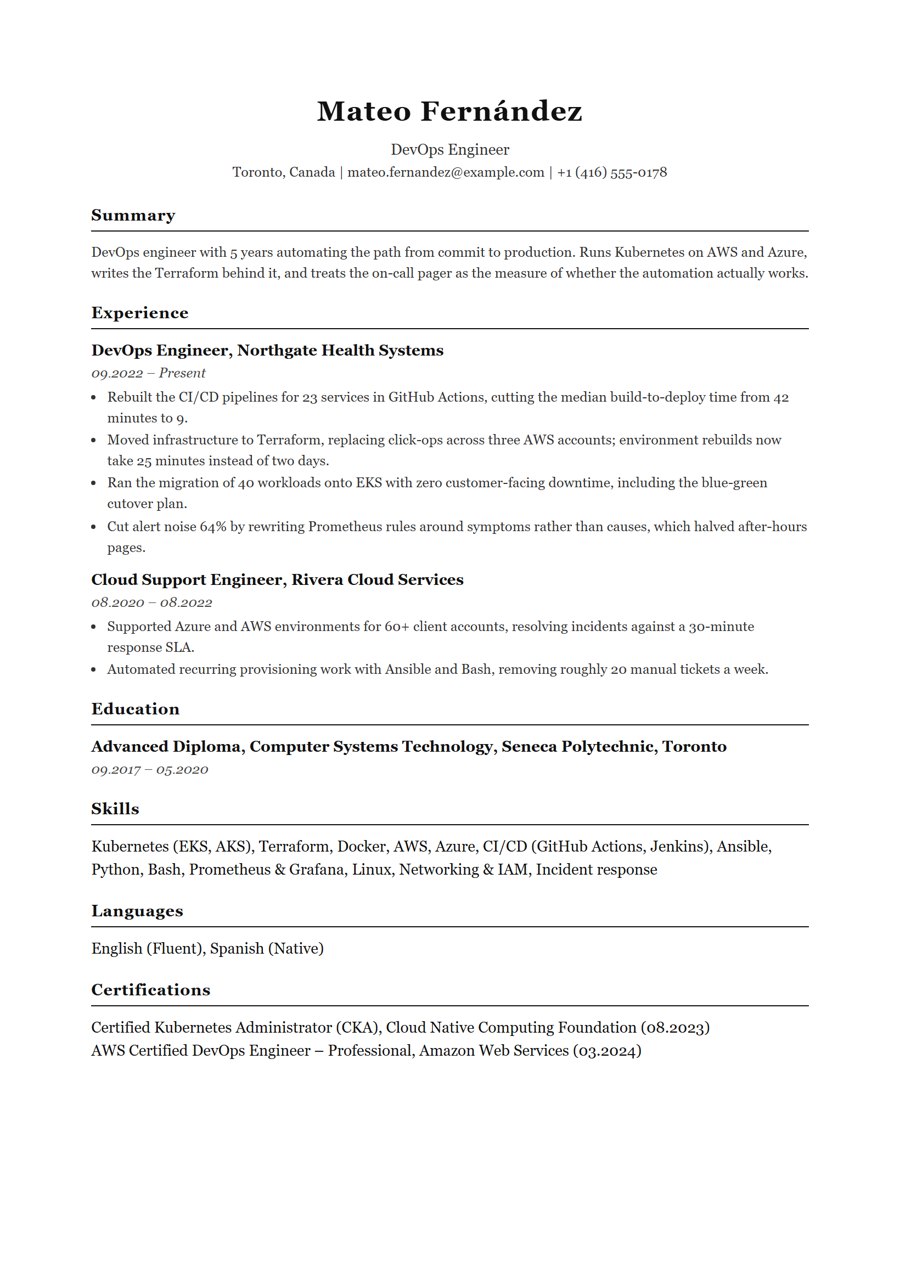
A one-page DevOps engineer resume example built from 10 live postings — Kubernetes, Terraform, CI/CD and the numbers that prove the automation worked.
Why this example works
Automation is the headline, not the tool list
"Automation" was mentioned 29 times across the postings we sampled — more than any single tool. Every bullet here names something that used to be manual and now isn't.
The numbers are operational, not vanity
42 minutes to 9, two days to 25 minutes, 64% less alert noise. These are the metrics a platform team is actually judged on, and they tell a hiring manager what your week looks like.
On-call is mentioned deliberately
Halving after-hours pages is a DevOps outcome that other engineers immediately understand. It also signals that this person owns what they ship rather than handing it over.
Certifications belong on this resume
CKA and the AWS professional cert are screened for in a way that rarely happens for, say, a frontend role. Both are current, and both are relevant to the stack above them.
One page at five years
Two roles, six bullets between them. There's no third job padding the page and no 'Objective' section to skip past.
What devops engineer postings actually ask for
We pulled 10 live postings (DevOps engineer, Canada) on 24 September 2026 and counted what they mention — counted across all 10 descriptions, so a posting that repeats a term counts each time. The example above uses these terms where they are genuinely true of the person, which is the only way to use them.
| Term | Mentions across those postings |
|---|
| Automation | 29 |
| CI/CD | 19 |
| Kubernetes | 13 |
| AWS | 13 |
| Azure | 12 |
| Monitoring | 12 |
| Docker | 9 |
| Infrastructure as code | 9 |
| Terraform | 8 |
| Jenkins | 7 |
| Python | 7 |
| Ansible | 6 |
| GCP | 6 |
| Networking | 6 |
How those postings describe the work, in their own words:
- “design, build and maintain CI/CD pipelines and deployment automation”
- “manage cloud infrastructure as code across multiple environments”
- “improve observability, monitoring and incident response practices”
- “partner with development teams to embed security and quality earlier in the pipeline”
- “drive continuous improvement of platform reliability and developer experience”
Mistakes to avoid on a devops engineer resume
The tool soup skills section
Thirty tools in a row tells nobody what you can run in production. Group them, keep them to what you'd be comfortable debugging at 3am, and show them in the bullets.
No mention of reliability or on-call
Pipelines are half the job. If nothing on the resume mentions incidents, monitoring or uptime, a hiring manager will assume you haven't carried a pager.
Confusing 'we migrated' with 'I migrated'
Platform work is collaborative, so be exact about your part. Owning the cutover plan is a specific, credible claim.
Listing every cloud equally
AWS, Azure, GCP, Oracle and Alibaba on one line reads as course completions. Name the ones you've run something real on.
Frequently asked questions
DevOps engineer or platform engineer — which title should I use?+
Use the one on the posting you're applying to. The postings we sampled used both, often for the same work. Your bullets carry the meaning; the title just has to be findable.
Do I need certifications for a DevOps role?+
They help more here than in most engineering roles, because CKA and the cloud professional certs are concrete and often screened for. They don't replace having run something in production.
Should I list every tool in my stack?+
No. Name what you'd be comfortable debugging under pressure. An interviewer will pick the least likely item on your list and ask about it.
How do I show impact when my work is invisible when it goes well?+
Measure the before and after: deploy time, failure rate, recovery time, page volume, cost. Those four numbers are the whole argument for your role existing.
Is a one-page resume enough for a senior DevOps role?+
Up to about six years, yes. Past that, two pages is normal — see our software engineer example for how the extra page is used.
Read next