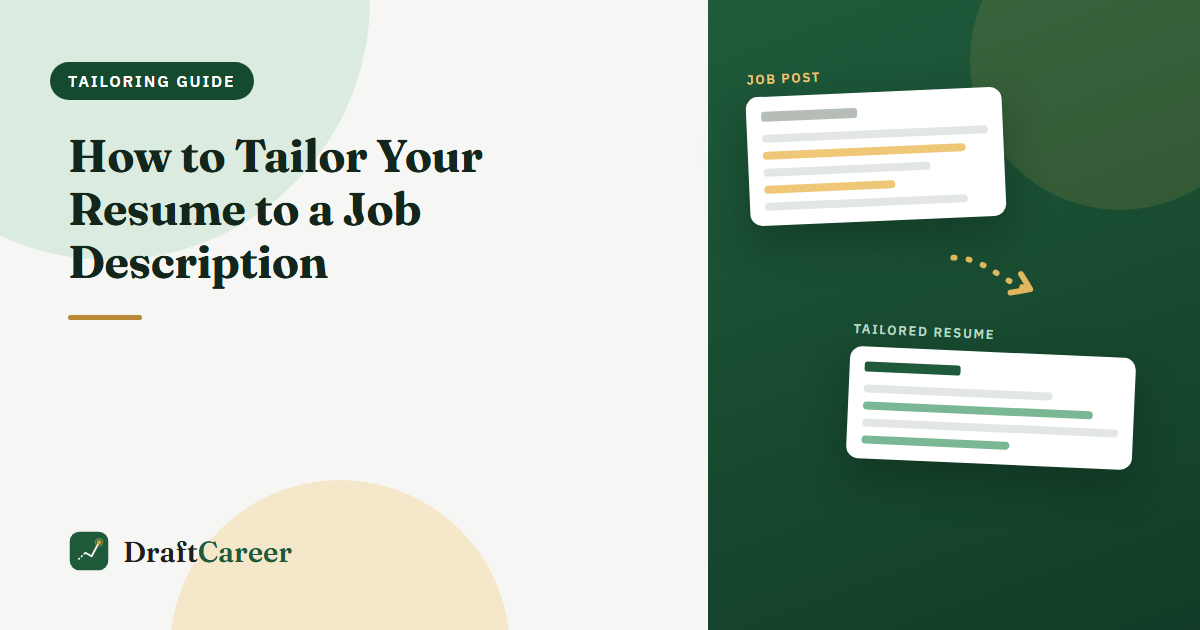
One resume sent to 50 jobs is often why you're not hearing back. Recruiters — and the ATS — reward resumes that clearly match the specific role. Tailoring doesn't mean rewriting your whole career for each job; it means reordering and rephrasing so the match is obvious in six seconds. Here's the repeatable process.
Step 1: Pull the keywords from the job description
Read the posting and highlight the repeated skills, tools, and phrases — especially anything in the "requirements" section. Those are the terms the ATS scores and the recruiter scans for. Make a quick list.
Step 2: Mirror the language you genuinely match
For every keyword that's true for you, make sure it appears in your resume using the posting's wording. If they say "customer success" and your resume says "client support," align to their term (as long as it's honest). Never claim skills you don't have — it falls apart in the interview.
Step 3: Reorder for relevance
Move your most relevant experience and bullet points to the top of each section. The most important qualification for this job should be in the top third of the page, not buried on line 20.
Step 4: Rewrite your summary for this role
A two-line summary tuned to the job is one of the highest-impact edits. Name the role and your most relevant strength.
Step 5: Tailor 3–5 bullets, not all of them
You don't need to rewrite everything. Adjust the handful of bullets that speak most directly to the posting so they use its keywords and emphasize matching results.
Before / after example
Here's the whole process on one bullet. Step through the three tabs — the highlighted phrases are the keywords travelling from the posting into the rewrite:
Four phrases repeat in the requirements. Those are your keyword list — nothing else here needs to change your resume.
True, but invisible. It never says which channel, which tool, or what actually improved — so it matches nothing the recruiter is scanning for.
Nothing invented — the same work, described in the posting's own words, with the result attached.
That's the whole move. You didn't change your career; you changed which parts of it are visible in six seconds.
Same job, same truth — but the tailored version mirrors the posting's keywords and proves the result with numbers. That's what gets you past the filter and onto the shortlist. If the formatting side is also worth a look, we cover it in how to make a resume that passes ATS.
Do this in minutes, every time
Tailoring by hand for every application adds up. This is exactly where AI helps: paste the job description and let it draft a matched resume and cover letter, then edit for accuracy and voice. DraftCareer does this in one click and keeps every version organized with its application tracker — so tailoring stops being the reason you skip applying. (However you do it, keep the final say human: verify every claim is true before you hit send.)