Most resume advice focuses on what looks impressive. The more useful question is what gets read. A recruiter opening your resume is not settling in for a careful study of your career — they are making a fast keep-or-reject call, often while working through a stack of dozens or hundreds of other applicants for the same role. Surveys on exactly how fast disagree with each other: some eye-tracking research has put the initial scan in the single-digit seconds, while other recruiter surveys report a more deliberate 30 to 60 seconds on a first look. The honest takeaway isn't a precise number — it's that you have very little time to prove you're worth reading closely, and everything below is about winning that first pass.
How to structure a resume so nothing important is missed
A resume that requires effort to parse loses before the content is even judged. That means a predictable structure: contact details, a short summary or none at all, work experience in reverse-chronological order, education, and skills. Recruiters have seen thousands of resumes and expect to find things in familiar places — this is not the place to get creative with layout.
A few structural points that consistently come up in hiring guidance:
- Length should match experience, not habit. If you have under roughly five years of experience, one page is usually enough. More experienced candidates can reasonably run to two pages, but padding a thin one-pager to two just to look substantial works against you.
- Keep contact information in the main body of the page, not in a header or footer — some parsing systems don't read those sections reliably, and it costs you nothing to be safe.
- Avoid multi-column layouts, tables, text boxes, and decorative graphics. They can look sharp to a human eye but scramble badly when a system tries to extract the text, and even when read correctly by software, they often force a human reader to hunt for information rather than scan it.
- Stick to a standard, readable font at a normal body-text size, with enough margin that the page doesn't feel cramped.
On the subject of automated screening: you'll often hear that the majority of resumes are rejected by an "ATS" before a human ever sees them. That specific claim traces back to a marketing pitch from over a decade ago with no real study behind it, and more recent surveys of actual recruiters push back on it — most say their systems don't auto-reject resumes outright. The practical implication is that you shouldn't obsess over "beating the ATS" as if it were an adversary to trick. Just format cleanly, because clean formatting also happens to be what makes a resume easy for a human to skim, which is the thing that actually matters.
You do not need paid software for any of this — a plain document works. We set out where a free resume builder stops being enough if you would rather not write the formatting yourself.
Write accomplishments, not job descriptions
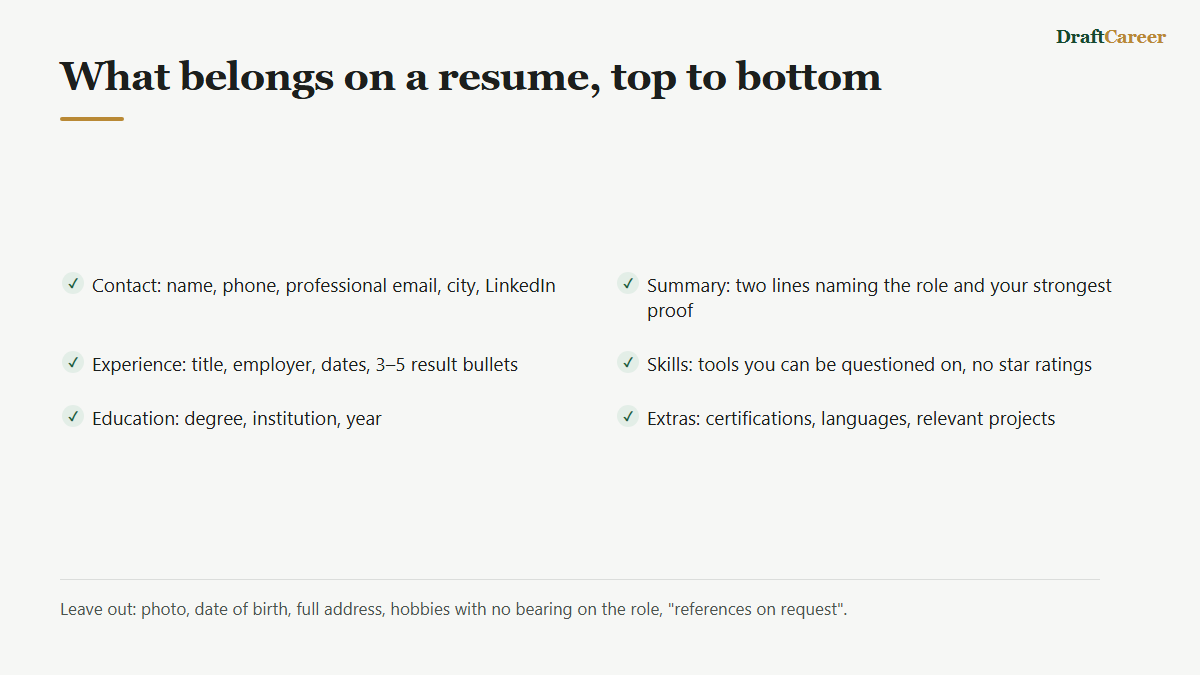
The single biggest difference between a resume that gets a callback and one that doesn't is usually not formatting — it's whether the bullet points describe outcomes or just describe the job. "Managed a team of five" is a duty. "Managed a team of five and cut onboarding time from six weeks to two" is an accomplishment. The second version tells a hiring manager what changed because you were there, which is the actual question they're trying to answer.
A few practical habits:
- Quantify wherever you honestly can. Numbers don't have to be dramatic — a 12% improvement is still concrete evidence, and concrete evidence is what separates a real claim from a vague one. Multiple recruiter surveys point to measurable achievements as the single thing that makes a resume stand out most, more than any particular phrasing or keyword.
- Lead each bullet with a specific action verb — built, negotiated, reduced, launched, redesigned — rather than a flat "responsible for" or "helped with." "Responsible for" describes a job title's scope; a strong verb describes something you actually did.
- If you genuinely can't quantify something, describe the before-and-after instead. "Rewrote the onboarding documentation, cutting new-hire questions to the support team noticeably" still communicates change even without a hard number, and it beats inventing a statistic you can't back up in an interview.
- Cut anything that's purely a duty with no outcome attached. If a bullet point could describe literally anyone who held that job title, it's not doing any work for you.
One more thing worth saying plainly: don't fabricate numbers. An interviewer who asks you to walk through the 30% improvement you claimed will notice immediately if you can't explain where it came from, and that's a worse outcome than a slightly less impressive but truthful bullet point.
What belongs in each section, and what doesn't
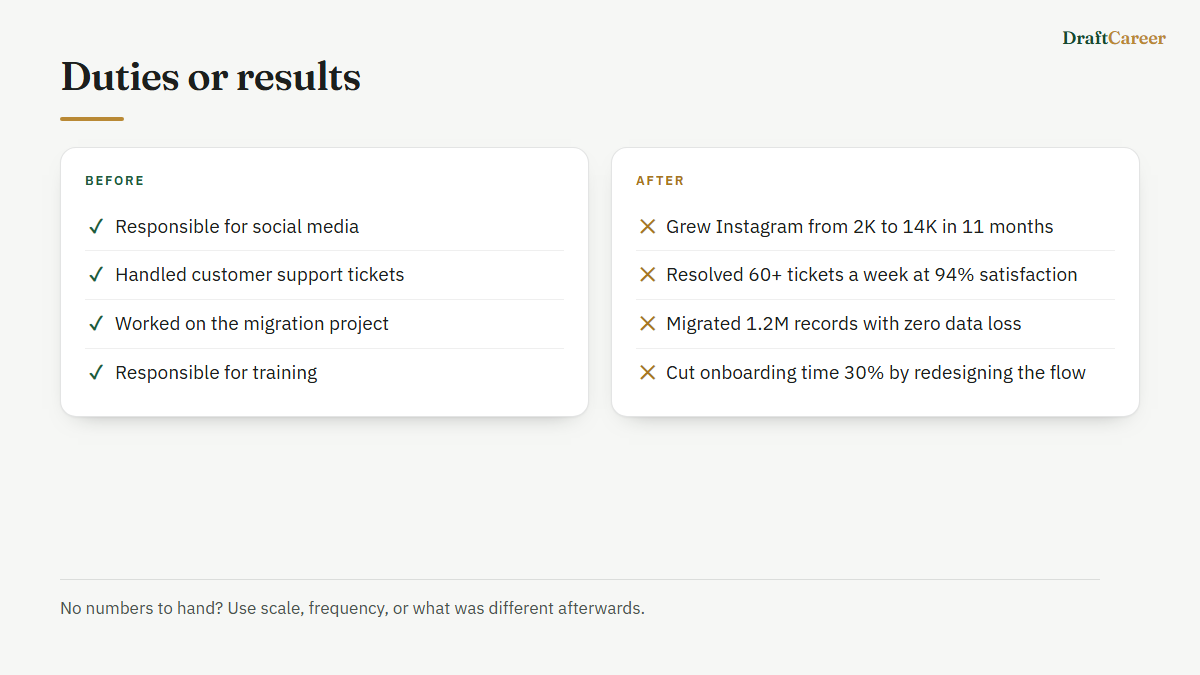
| Section | Include | Leave out |
|---|---|---|
| Contact | Name, phone, professional email, city, LinkedIn | Full street address, date of birth, marital status, photo (US/UK/CA/AU) |
| Summary | Two lines naming the role and your strongest relevant proof | "Hard-working team player seeking opportunities" |
| Experience | Title, employer, dates, 3–5 result bullets | Copy-pasted job descriptions, every task you ever did |
| Skills | Tools and skills you can be questioned on | Star ratings, bars, "Microsoft Word" |
| Education | Degree, institution, year; grades while early-career | School results once you have a degree and experience |
| Extras | Certifications, languages, publications, relevant projects | Hobbies with no bearing on the role, references on request |
Tailor it to the job you're actually applying for
A generic resume sent to twenty different job postings is easy to spot, and it reads as generic because it is. The fix isn't rewriting your whole resume from scratch for every application — it's keeping one strong, complete "master" version of your experience, then adjusting the emphasis and language for each specific role before you send it.
In practice that means reading the job description closely and noticing the language it uses for the skills and responsibilities that matter most, then reflecting that same language in your resume where it's actually true of your experience. If a posting repeatedly emphasizes "cross-functional collaboration" and that's genuinely part of what you did, use that phrase rather than a synonym you happen to prefer. This isn't about stuffing in keywords you don't actually have experience with — that tends to be obvious to a reader and can backfire badly if you get to an interview and can't speak to it. It's about making the overlap between what you've done and what they're hiring for as easy to see as possible, for both a scanning algorithm and a scanning human.
Write it once, reuse it everywhere.
Answer a few questions and DraftCareer drafts the first version, keeps your history in one place, and renders it into any template. Build one free — no watermark on the PDF.
Mistakes that quietly kill an otherwise good resume
Some of the most common rejection reasons have nothing to do with a candidate's actual qualifications:
- Typos and grammatical errors. This shows up in survey after survey as one of the fastest ways to get set aside, and the tolerance for it has only dropped now that free proofreading tools are everywhere — a typo reads less like a slip and more like a sign you didn't bother to check.
- Being vague instead of specific. "Improved team performance" says nothing. "Improved team performance" plus how, and by how much, says a lot.
- Writing that sounds obviously AI-generated. A growing share of hiring managers say they can spot machine-generated resume text, and the tells are usually the same: generic phrasing, repetitive sentence structure, and claims with no specific detail behind them. If you use AI tools to help draft, edit hard afterward so the result sounds like you and is anchored in specifics only you would know.
- Listing responsibilities instead of results, as covered above — it's common enough to repeat.
- Ignoring basic readability in favor of a "designed" look — dense paragraphs, tiny fonts, or inconsistent formatting between sections all make a recruiter work harder than they're willing to for a first pass.
None of these are exotic problems, which is exactly why they're worth checking for deliberately rather than assuming they don't apply to you. A resume that's clean, specific, and honestly tailored to the role in front of you will outperform one that's merely long or elaborately formatted — because the person reading it is not looking to be impressed by design. They're looking for a fast, credible answer to one question: is this person worth a closer look?