No response after applying gets blamed on "the ATS" almost by default. Sometimes that's accurate. Often it's a stand-in for a handful of different problems that have nothing to do with each other, some fixable in ten minutes and some not really about the software at all. Here's what's actually behind the silence, roughly in order of how common each one is.
1. Your resume didn't parse the way you think it did
This is the most genuinely "ATS" reason on this list. If your resume uses a multi-column layout, text boxes, header-only contact info, or icons standing in for skills, a parser can garble or drop that information entirely — not because you're underqualified, but because your data landed in the wrong field, or no field at all. The mechanics of how parsing actually breaks are worth understanding once, since the fix is almost always the same: a single-column layout with standard section headings.
2. It's a clean parse, but a weak match
A resume can parse perfectly and still rank low if it doesn't reflect the language of that specific posting. This is different from formatting — it's about substance. If a job description repeatedly mentions "stakeholder management" and your resume says "worked with clients" without ever using terms closer to what the posting asks for, a keyword-sensitive ranking step can push you further down a list even though you may have done exactly that work. This is the one thing worth actually tailoring per application, rather than sending one generic version everywhere.
3. A knockout question filtered you out before a human ever looked
Many application flows include a short set of screening questions set by the employer — work authorization, a required license, willingness to relocate — and an automatic "no" on one of those can end an application immediately, independent of your resume's quality. This is real automatic rejection, but it's a narrower and more deliberate thing than "the algorithm didn't like my resume": a human configured that specific question to be disqualifying, and the system is just enforcing it.
Harvard Business School's Hidden Workers research makes the same point from the employer's side: rigid screening criteria, set by people, filter out capable candidates long before any algorithm is to blame.
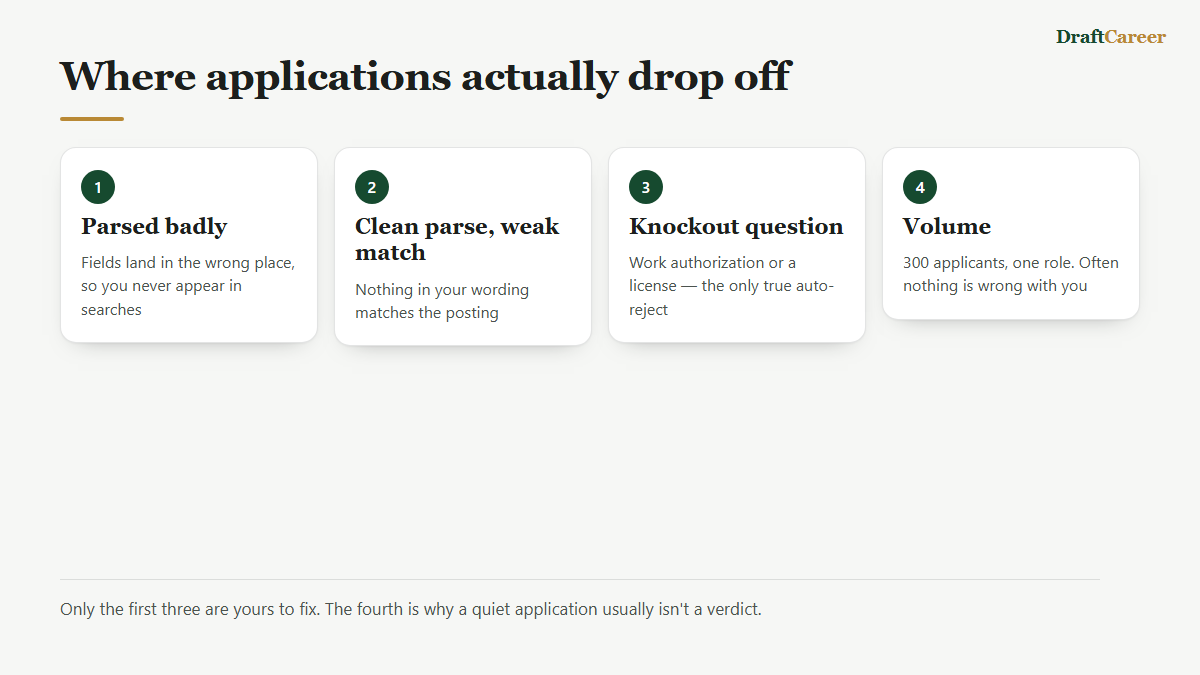
4. It's not the ATS at all — it's volume
This is the reason least likely to feel satisfying, and the most likely to actually be true for a strong, well-tailored application that still goes nowhere: a popular posting can draw hundreds of applicants for one opening, and a recruiter working through a ranked list often stops well before the bottom simply for lack of time, not because of an automated cutoff. Survey data from working recruiters tends to back this up — most say they're not running a hard auto-reject on formatting or keyword count, they're triaging volume under real time pressure. That's a genuinely different problem than "my resume is broken," and no formatting fix solves it.
And if you have been feeding your file to a third-party checker for a score out of 100: that number is not what the employer sees. Here is what it actually measures.
What a rejection five minutes after applying means
A rejection that arrives almost immediately feels like proof that a machine threw you out, and in one narrow sense it is: a knockout question answered the "wrong" way, or a filter on a required certification, can trigger an automated response within minutes. It is not a judgement on your resume, because nothing read it.
A rejection days or weeks later is the opposite: a person worked through a list and got to you. That one is worth taking as feedback about fit or competition, not formatting. And no response at all — the most common outcome by far — usually means the role was filled from higher up the list and nobody closed the loop.
5. The basics got missed somewhere in the pipeline
Occasionally it's simpler than any of the above: a resume uploaded as an unusual file type, a form field left blank because a parser couldn't find contact info, or an application that technically never completed submission. Worth a quick sanity check before assuming the worst — confirm the application actually went through, in whatever format the posting asked for.
How many applications should it take?
Part of what makes silence so hard to read is not knowing what normal looks like. It is common for a well-targeted search to run at roughly one interview for every ten to twenty considered applications, and worse in a crowded field or against a hiring freeze. A run of twenty quiet applications is disappointing and entirely ordinary; it is not, by itself, evidence that your resume is broken.
What genuinely shifts the odds is rarely another round of formatting. It is applying to fewer roles that fit you better, getting a referral where you can, and reaching a person directly at smaller companies where no tracking system stands in the way. Quality of targeting beats volume of applications, and both beat re-editing the same document a seventh time.
One useful test before you conclude anything: send the same resume to a small company that accepts email applications. If that route gets replies and the portals never do, formatting is worth another look. If neither does, the problem is positioning, not parsing.
Rejected by an ATS? What's actually worth fixing
Of the five, only two are really about your resume itself: parsing (fixable once, structurally) and match strength (worth doing per application, not universally). The other three — knockout questions, volume, and submission mechanics — aren't things a better-formatted resume solves, and it's worth not spending more editing time chasing a cause that isn't the actual one.
So how do you beat the ATS?
This is the question we get asked most, and the honest answer is that you don't beat it, because there is nothing there to beat. No score to game, no bouncer at the door. What you can do is hand the software a document it can read without having to guess — and that turns out to be a short, checkable piece of work rather than a dark art.
Parsing and screening are two different steps
Nearly every piece of confusing ATS advice comes from treating these as one thing. Parsing is the software reading your file and sorting it into fields: name here, employer there, dates, skills. Screening is what happens afterwards, when a recruiter filters and ranks those records.
Which means a parsing error is not an automatic no. The recruiter can usually still open your original file. What the error really does is make you harder to find, harder to rank and easier to scroll past — because your experience ended up in the wrong field, or in no field at all.
That is the bar, and it is a lower one than most people assume. You are not outwitting a gatekeeper. You are formatting a document for a reader that can't infer anything.
Six failures that show up in real parsing data
These came to us from a recruiter who spent a stretch of their career validating a resume-parsing product — checking, resume by resume, what the software pulled out against what the page actually said, at something like 50,000 a month. Not one of them is exotic. Every single one looks completely fine to a human.
| Failure | What the software sees | Fix |
|---|---|---|
| Skills in tables, grids or columns | Everything runs together: DjangoSQLReactWord | One simple list, separated by commas or standard bullets |
| Name in a text box, graphic or styled header | The parser can't work out which text is your name | Full name at the top, as plain selectable text |
| Em dashes, smart quotes, arrows, decorative bullets | Characters turn to noise or disappear, worse on older systems | Standard bullets and plain punctuation |
| Dates in a separate column from the job title | Employment dates attach to the wrong employer | Keep dates beside the role, one format throughout: Jan 2022 - Mar 2026 |
| Two-column layouts | Sidebar text interleaves into your work history; sections come out in the wrong order | Single column is safest. A well-built two-column template can survive it, but test yours |
| A PDF that is really an image | No extractable text at all | Open the PDF and try to select the text. If nothing highlights, nothing parses |
The two-column row is the one we'd underline. Your resume looks immaculate on screen, the extracted text is unusable, and there is no way to catch it by reading your own document — which is the whole trouble with formatting failures. They are invisible from exactly where you are sitting.
Let AI write the words. Don't let it build the file.
AI is genuinely good at the writing part. Give it your experience and the job posting and it will tighten your bullets, surface the skills that matter and make results read like results. Check the facts, cut whatever isn't true, and the output is usually better than what most people manage unaided.
Producing the actual document is where it falls apart. Ask a chatbot for a finished, formatted resume and you tend to get drifting spacing, strange layout decisions and text that extracts badly — precisely the failures in the table above. Strong content, broken file.
So split the job. Let AI draft and rewrite; let something built for the purpose produce the file. That split is how we built DraftCareer, and it's why our templates are tested against what comes out of them, not only against how they look on screen. However you make your PDF, the finished thing needs selectable text and a reading order that makes sense.
Three things people get wrong
"The ATS rejects you for formatting." Mostly it doesn't. Parsing and screening are separate steps, and a recruiter can usually still open your file. Bad formatting costs you accuracy and visibility — not an automatic rejection.
"Play it safe with a plain, ugly document." Parsing has improved a great deal. Modern systems handle plenty of well-built designs, some two-column ones included. What you want is a structured, parsing-tested template, not a resume with every trace of design stripped out of it.
"Keywords are the whole game." Keywords matter, and most people already know that much. Formatting is the part nobody checks, because the failure doesn't show: your resume looks right on your screen while the extracted version reads like nonsense.
Run this before you submit
Seven checks, about two minutes, and you need nothing but your PDF and a plain text editor.
- Open the PDF and drag-select the whole thing. Every line should highlight.
- Copy all of it into a plain text editor and read what comes out — that is roughly what the software sees.
- Check the order survived: no skills spliced into the middle of a job, no dates attached to the wrong employer.
- Confirm your name is the first real text on the page, not an image or a header element.
- Check your section headings are the ordinary words: Experience, Education, Skills.
- Replace decorative bullets, arrows and smart quotes with plain equivalents.
- Make sure every date reads the same way and sits next to the role it belongs to.
The copy-into-a-text-editor step finds most of it on its own. Everything on that list stays hidden until you stop looking at the page and start looking at the text that comes out of it.
Rule out the causes you control, in two minutes.
Our free ATS checker does that last step for you — paste your resume in and it shows you what a parser extracts, and which fields it could and couldn't find. No account, no email. Then work through the 11 fixes that stop auto-rejection, or start from an ATS-safe template and skip the formatting problem altogether.