You run your resume through a scanner and it hands back "72% ATS match." A different tool gives the same document 91%. A third one doesn't score it at all, just lists warnings. None of them agree, and none of them tell you what a recruiter at the company you're applying to would actually see. That's not a bug in any one tool — it's because "ATS score" isn't a standard, universal thing to begin with.
What an ATS resume score actually measures
Most free resume scanners work the same way under the hood: they parse your document into text, compare that text against the job description you paste in (or against a generic keyword list if you don't), and produce a percentage based on how much overlap they find. Some also run basic formatting checks — single column or not, standard section headings or not — and fold that into the same number.
That's a genuinely useful diagnostic. Keyword overlap with a real posting is a reasonable proxy for relevance, and a formatting check can catch real parsing problems before you submit anywhere. What it isn't is a preview of a hiring decision, or even a preview of what the employer's actual system shows.
What a real ATS shows a recruiter
The systems companies actually use — Workday, Greenhouse, iCIMS, Oracle Recruiting, SAP SuccessFactors and the rest — are recruiting platforms rather than resume graders, and they don't typically hand a recruiter a single public-facing percentage the way consumer scanning tools do. What a recruiter sees is closer to a structured record (your parsed name, employers, dates, skills) and, in systems with matching features turned on, a sorted list of candidates ranked against the requisition. Some newer platforms do surface an internal match score to recruiters, but it's rarely the headline number the job seeker ever sees, and it isn't computed the same way two different consumer tools compute theirs. There's no one formula being reverse-engineered here — every ATS parses and ranks a little differently, which is exactly why a single "your score is 84%" claim from a free tool can't be a precise prediction of anything.
What is a good ATS score?
There is no official scale, so the honest answer has two halves.
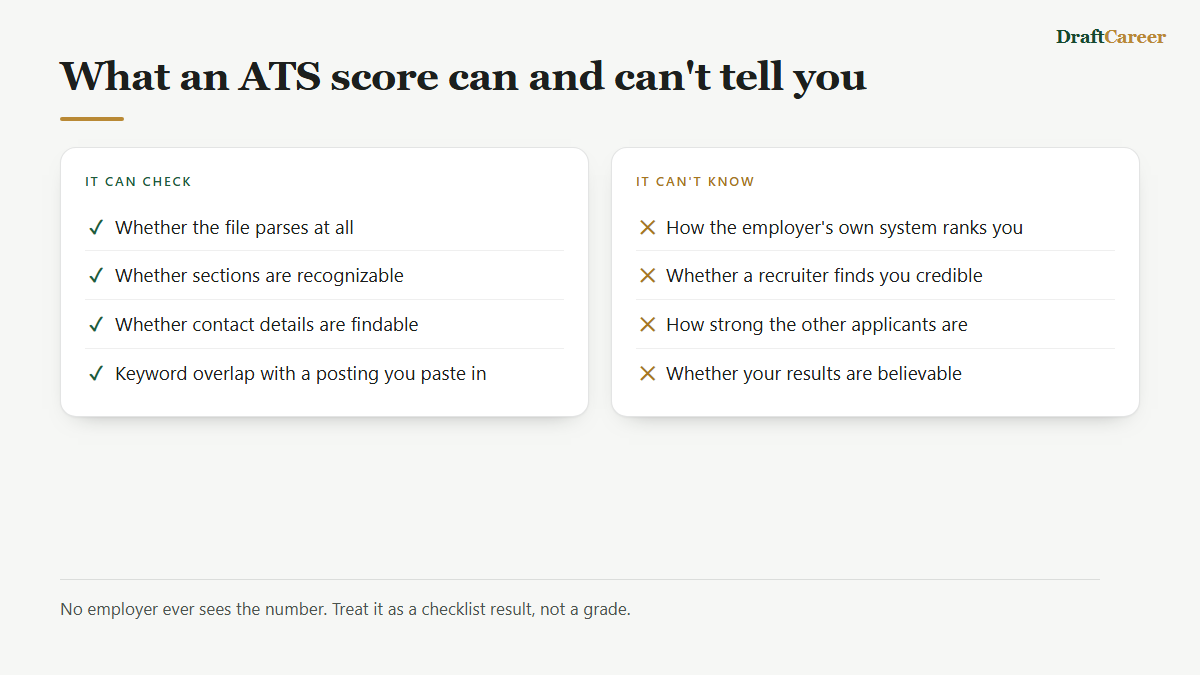
For the formatting half of the score, aim for everything green. Whether a file parses, whether sections are recognisable, whether your contact details can be found — these are objectively right or wrong, and anything flagged should be fixed regardless of what percentage sits next to it.
For the keyword half, 70–80% against a specific job description is a realistic target, and chasing higher usually makes the resume worse. A perfect match means you have copied the posting, which reads badly to the human who opens it next. If a tool scores you under about 50% against a job you genuinely fit, that is worth investigating: usually your wording and the employer's have drifted apart, not your experience.
The important caveat: these numbers come from a third-party tool guessing at what the employer's system does. The employer's own ATS may not compute a score at all, and if it does, it uses its own formula on its own requisition. Treat a checker's number as a proofreading pass, not a grade.
Why two tools score the same resume differently
Run one document through three checkers and you will get three numbers. That is not one of them being broken; it is four differences stacked on top of each other.
- What they compare against. A tool you paste a job description into is measuring overlap with that posting. A tool you don't is measuring overlap with a generic list for a job title it guessed. Those are different questions with the same label.
- How they weight things. One checker might put 70% of the score on keywords and 30% on formatting; another splits it evenly; a third quietly penalises anything over one page. None of them publish the formula.
- Whether they understand synonyms. Older matching is literal: "client management" and "stakeholder management" are unrelated strings. Newer matching treats them as close. The same resume scores very differently under each.
- Their own parser. Before anything is scored it has to be read, and two parsers handle a two-column layout or an unusual date format differently. A low score sometimes just means that tool struggled with your file.
There is one case where the disagreement is itself useful information: when every tool you try produces a low score or mangles the same section, that is a parsing problem rather than a scoring quirk, and it will follow you into the employer's system too.
So is the score pointless?
Not pointless — just easy to over-trust. Treat a score the way you'd treat a spell-checker's underline: a signal worth investigating, not a grade to optimize toward. If a tool flags that your resume is missing terms the posting uses repeatedly, that's worth a look — maybe you do have that experience and just phrased it differently. If a tool flags a formatting issue (a table, a text box, an icon standing in for a skill), that's worth fixing regardless of what percentage it produces, because parsing failures are a real, well-documented problem independent of any scoring gimmick.
What's not worth doing is chasing the number itself — rewriting a resume sentence by sentence to nudge a free tool's percentage from 78% to 95%. Two different scanners will disagree with each other, and neither one is the system the employer is actually running.
A score is only useful if it tells you what to change.
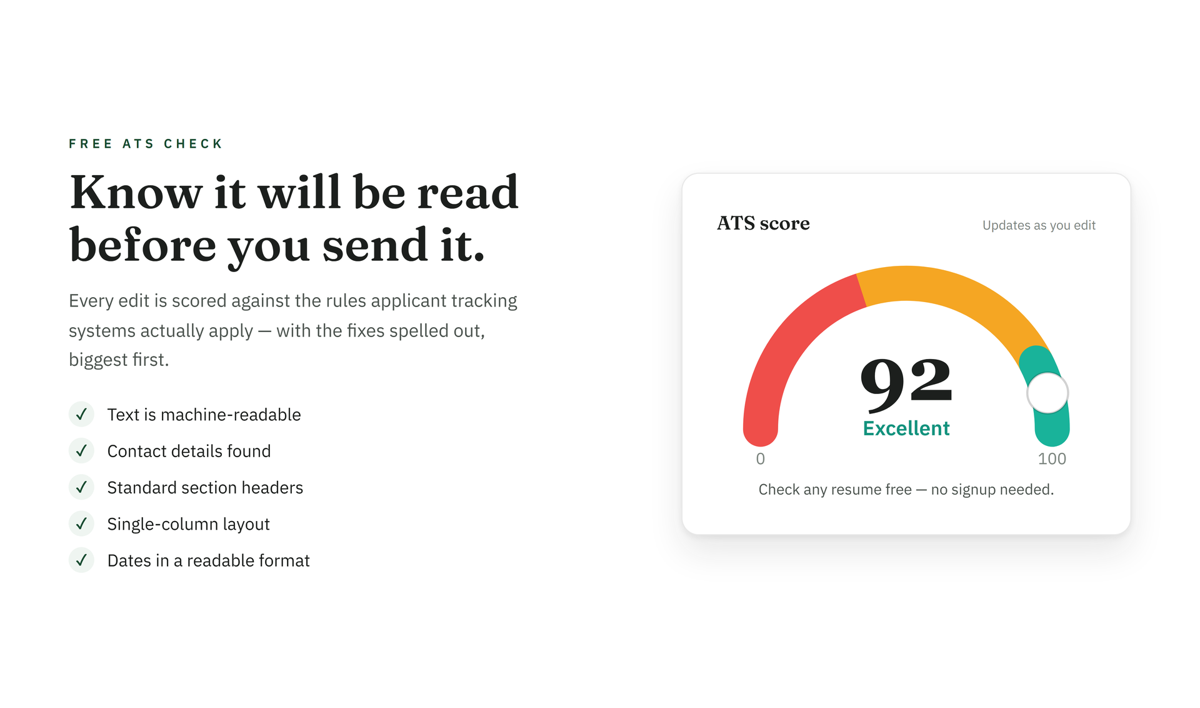
DraftCareer's free ATS checker lists the specific issues it finds — structure, missing sections, contact details in the header, keyword overlap with a job you paste in — instead of handing you a number out of 100.
How to use a score without chasing it
- Paste in the actual job description rather than scoring against nothing.
- Read the flagged items, not the number — the list is the useful part.
- Fix every structural flag, because those are objectively wrong regardless of tool.
- Add only the keywords you can back up with real experience, in a sentence that carries a result.
- Stop. A second pass to lift 78% to 92% changes nothing an employer will ever see.
What to check instead
- Does it parse cleanly? Single-column layout, standard section headings, contact info in the body rather than a header or graphic — the structural basics that let any parser read you correctly.
- Does it actually match the posting's language? Not keyword-stuffing — genuinely reflecting the skills and terms that specific job description uses, where you truthfully have that experience.
- Would a human reading it for thirty seconds understand what you do? A resume that scores well on a keyword tool but reads as a jumble to a person hasn't actually solved the problem.
If you want a straightforward check on the structural side without a mystery percentage attached, DraftCareer's free ATS compatibility checker scans for the specific formatting issues that cause real parsing failures, rather than producing a score built on an unknown formula.