"Should I send a CV or a resume?" is a genuinely confusing question, because the honest answer is "it depends which country's definition you're using" — and the two definitions aren't just slightly different, they describe documents of a completely different length and purpose. Getting this wrong doesn't just look like a wording slip; sending the wrong document to the wrong audience can read as not having done basic homework on the application.
What does CV stand for?
CV is short for curriculum vitae, Latin for "course of life". That literal meaning is the source of the confusion: in North America the word kept its original sense of a complete academic record, while in the rest of the world it drifted to mean simply "the document you send with a job application". Both usages are correct in their own region, which is why the same question has two right answers.
Which is better, a CV or a resume?
Neither is better. They are answers to different questions, and the only thing that decides it is where you are applying and what the posting calls for:
- Outside North America the question dissolves — a CV there is the one-to-two page document, so build that and call it a CV.
- In the US or Canada, for an industry job, send a resume. A long academic CV reads as not having understood the application.
- In the US or Canada, for a research, faculty or clinical post, send the academic CV. A one-page resume there reads as underqualified.
If a posting is ambiguous and the employer is international, a concise two-page document titled "CV" is the safest choice. It is what the majority of the world means by the word, and no US recruiter has ever rejected a well-made two-page summary for being called the wrong thing.
The US/Canada meaning: two different documents
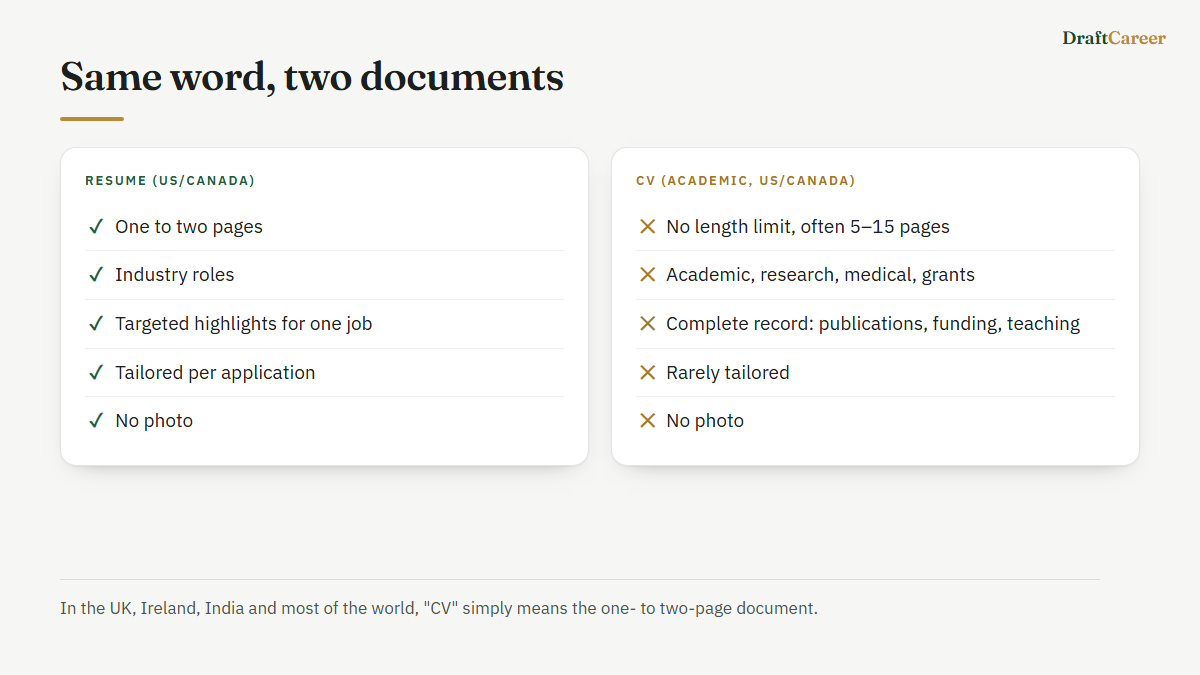
In the United States and Canada, "resume" and "CV" (short for curriculum vitae) refer to two genuinely different things used for different purposes:
- A resume is a concise, one-to-two-page summary tailored to a specific job, focused on relevant work experience, skills, and achievements. This is what almost every job application in the US and Canada expects, across essentially every industry outside academia.
- A CV in this context is a comprehensive, often multi-page academic record — every publication, presentation, grant, research role, and teaching position, arranged chronologically without trimming for relevance. It's used almost exclusively for academic, research, and some medical or scientific positions, where the full scholarly history is the point.
If you're applying for a standard corporate, tech, or industry role in the US or Canada, you want a resume, not a CV, even if you've heard the terms used loosely elsewhere. Sending a ten-page academic-style CV for a product manager role will read as a mismatch with what was asked for.
The UK, Ireland, India, and most of the rest of the world: one document, two names
Outside North America — including the UK, Ireland, India, most of Europe, Australia, and New Zealand — "CV" is simply the standard term for what Americans call a resume: a concise, tailored summary of your work history and skills, typically one to two pages. There isn't a separate "resume" document expected alongside it. If a job posting in India or the UK asks for a CV, they mean exactly the document you'd call a resume in the US — same length, same purpose, same content expectations.
This is genuinely the more common source of confusion for job seekers in India specifically: if you're using tools or advice written for a US audience, "CV" might sound like a longer academic document you don't have and don't need, when really it's just the local word for the same one-to-two-page document you're already building.
The differences at a glance
| Resume (US/Canada) | CV (US/Canada, academic) | CV (UK, India, most of the world) | |
|---|---|---|---|
| Length | 1–2 pages | No limit; often 5–15 | 1–2 pages |
| Purpose | Industry roles | Academic, research, medical, grants | Almost every job |
| Content | Targeted highlights for one role | Complete record: publications, funding, teaching | Targeted highlights, same as a resume |
| Tailored per application | Yes | Rarely | Yes |
| Photo | No | No | Varies: common in parts of Europe, avoided in the UK |
International CV format: what changes by country
The length and structure barely move. What changes is which personal details are conventional, and getting that wrong is what marks an application as imported from somewhere else.
| Country | Called | Length | Photo | Date of birth | Other conventions |
|---|---|---|---|---|---|
| United States / Canada | Resume | 1–2 pages | No | No | No marital status; references on request is unnecessary |
| United Kingdom / Ireland | CV | 2 pages | No | No | A short personal statement at the top is normal |
| India | CV or resume, used interchangeably | 1–2 pages | Usually not | Still seen, not required | CGPA or percentage expected early-career |
| Germany / Austria / Switzerland | Lebenslauf (CV) | 1–2 pages | Common | Common | Often signed and dated; certificates attached |
| Singapore | CV or resume | 1–2 pages | No | Sometimes requested | Nationality or work-pass status often asked for |
| Australia / New Zealand | CV or resume | 2–3 pages | No | No | Longer is accepted; referees often listed |
| South Africa | CV | 2–3 pages | Sometimes | Common | ID number and language proficiency often included |
Where a photo or date of birth is optional, leaving it off is never held against you — and in the UK, US, Canada and Australia, including it can work against you because employers avoid anything that invites a discrimination claim. You can see the short document in both conventions in our resume examples by role.
CV vs resume: which one do you actually need?
The safest rule is to match whatever term and format the employer or job posting uses, in the region you're applying in:
- Applying in India, the UK, Ireland, Australia, or most of Europe → build a concise, one-to-two-page document. Call it a CV if that's the local convention, but structure and length-wise it's the same as a US resume.
- Applying in the US or Canada, to a standard industry role → build a concise resume, one to two pages, tailored to the job.
- Applying to an academic, research, medical, or scientific post anywhere → a full, comprehensive CV listing your complete scholarly and professional history is expected, regardless of country, and it's fine for this one to run long.
When genuinely in doubt — a posting that just says "send your CV/resume" without more context — default to the concise, tailored version. It's rare for a standard industry job to actually want the exhaustive academic-style document, even where "CV" is the word used for the short version.
One profile, either document.
DraftCareer stores your history once and renders it into whichever length and layout a country expects — a one-page resume for a US application, a two-page CV for a UK one — without retyping anything. Start free.
Building the concise version
For the overwhelming majority of job seekers — whether you're calling it a CV or a resume — what you actually need is the same thing: a clean, one-to-two-page document built around your relevant experience, readable by both a hiring manager and by the applicant tracking software many companies filter through first (worth a look if you haven't: how ATS screening actually works). DraftCareer's resume and CV builder works from a single profile you fill in once, then generates that document in whichever template fits your target market — with a free tier to try it before deciding whether you need more.