If you're a final-year student or a recent graduate applying for your first full-time technical role in India, you've probably heard some version of "the ATS will reject your resume before a human even sees it." That's an exaggeration, but there's a real pattern underneath it. Large IT services companies and most mid-to-large product companies hire freshers at volumes that make manual reading of every resume impossible, so they lean on software to filter, rank, or search applicants before a recruiter looks at anything. Understanding roughly how that filtering works — and what it can and can't do — is far more useful than trying to "beat" it with tricks.
What's actually happening when you apply
For campus drives and mass off-campus hiring at the big services firms, your application usually goes through a system that extracts your details into structured fields — name, education, CGPA or percentage, skills, projects — and then makes those fields searchable and sortable for a recruiter. Depending on the volume of applicants and the role, a recruiter might set filters (a minimum CGPA cutoff, a required skill, a specific degree) and only see candidates who clear them, or they might run keyword searches across a large pool of parsed resumes to shortlist people who mention the specific technologies a project needs. Product companies and startups tend to do less rigid filtering and more direct keyword matching against the job description, but the underlying idea is the same: your resume needs to contain the right information in a form software can actually read, before a person gets the chance to be impressed by it.
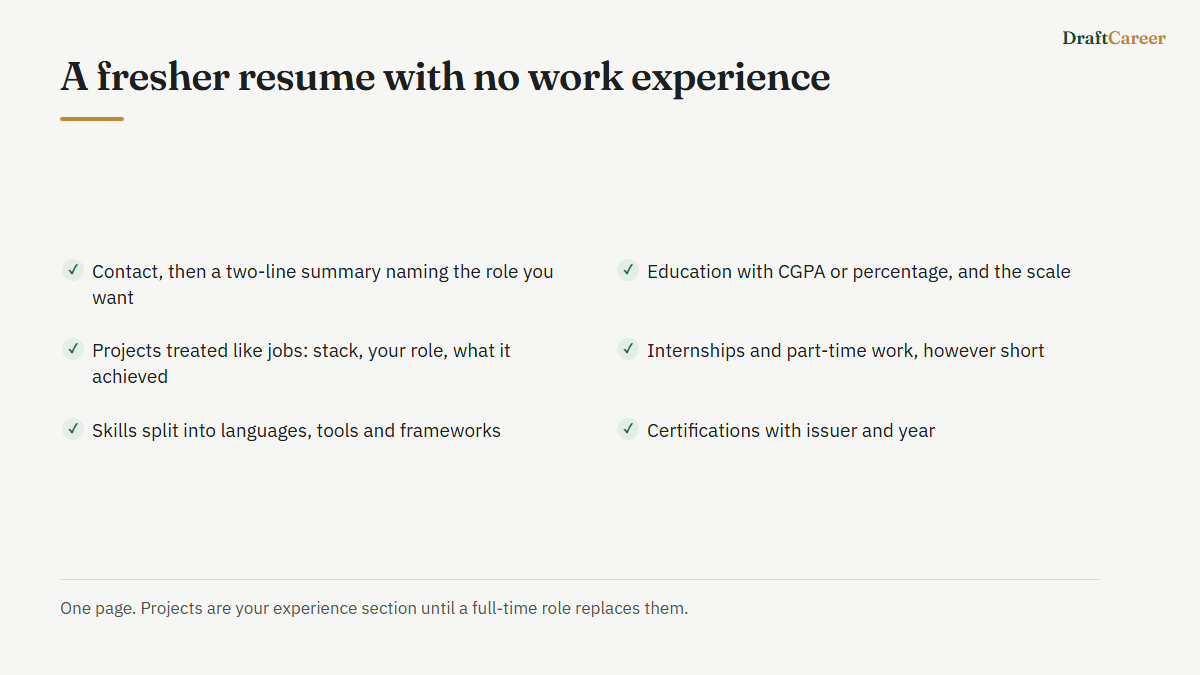
The practical upshot is that formatting choices that look fine on screen can quietly cause real damage. Multi-column layouts, resume templates built as an image or with heavy graphic design, tables used to lay out your skills, header/footer contact details, and icons standing in for section titles all risk being read incorrectly or skipped entirely by parsing software. None of this means your resume needs to look plain or dull — it means the underlying structure should be a single column of standard sections (Education, Skills, Projects, Experience/Internships, Certifications) using normal text, so that however a system extracts it, the important information survives intact.
CGPA and percentage: include them, and don't panic about them
This is one of the most common points of anxiety for freshers, and the honest answer is straightforward: in India, listing your CGPA or aggregate percentage alongside your degree is standard practice and expected, not optional the way it might be in some other countries. Most large recruiters, especially the mass-hiring services firms, still apply some form of minimum academic cutoff during the shortlisting stage, and application forms for campus drives typically ask for this figure directly regardless of what your resume says. Leaving it off doesn't hide a weak score — it just makes your resume look incomplete next to everyone else's, since a recruiter will see the number in the application system either way.
If your score is on the lower side, the better move is to make sure everything around it is strong: a solid project section, relevant certifications, and a skills list that matches what the role actually asks for. A recruiter scanning past a mediocre CGPA is much more likely to keep reading if the next few lines show real, applied technical work. Whether to also list your 12th and 10th grade marks depends on who you're applying to — services firms and campus placement cells in India commonly expect them, while for product companies and startups they matter far less and can usually be dropped once you have even a little professional or internship experience to show instead.
The keyword categories that actually matter for IT roles
Because a lot of fresher shortlisting is effectively a search against a skills field, it's worth being deliberate about what goes into yours rather than listing everything you've ever touched in a single unsorted line. For most entry-level IT and software roles in India, recruiters and their systems are typically searching across a handful of categories:
- Core programming languages relevant to the role — Java, Python, C++, JavaScript, and so on, named exactly as the job description names them rather than only as a general "programming" skill.
- Frameworks and libraries you've genuinely used in coursework or projects — for example Spring Boot, React, Node.js, Django, or Android/Flutter for mobile-focused roles.
- Databases — SQL specifically, and any exposure to a particular system like MySQL, PostgreSQL, or MongoDB.
- Cloud fundamentals — even basic, self-taught exposure to AWS, Azure, or GCP is increasingly expected as a baseline for entry-level roles, not just for people applying to specialized cloud positions.
- Version control and basic DevOps literacy — Git is close to universal, and terms like CI/CD, Docker, or Linux fundamentals signal that you understand how software actually ships, which matters even for a role that isn't formally "DevOps."
- Computer science fundamentals — data structures and algorithms, OOP concepts, DBMS, operating systems — these show up constantly in job descriptions for a reason, and naming them explicitly (not just implying them through a project) helps a keyword match.
The general principle behind all of this: read the actual job description for each role and mirror its specific terms where they're honestly true of you, rather than writing one generic skills list and sending it everywhere. A posting that says "REST APIs" should be matched with "REST APIs" in your resume, not just "backend development," even if you mean the same thing — parsing and keyword search often work on the literal terms.
No full-time job yet? Your projects are your experience
This is usually the part that worries freshers most, and it shouldn't. Recruiters hiring for entry-level roles in India are not expecting a work history — they're expecting evidence that you can apply what you've learned. Academic projects, internships (even short or unpaid ones), hackathons, and significant coursework can and should be written with the same structure you'd use for a job: what you built, what you used to build it, and what the outcome was.
A few things that make this section do real work for you:
- Name your tech stack explicitly in each project description, not just in a separate skills list — "Built a REST API using Node.js and Express, with MongoDB for storage" does double duty as both a description and a set of keywords.
- Describe outcomes, not just what the project was. "Reduced query response time by restructuring the database schema" tells a recruiter more than "made a web app," even for a college project.
- Include a link to your GitHub, and to your competitive programming or coding-platform profile if you have one worth showing — LeetCode, HackerRank, Codeforces, or similar. For technical freshers in India these are commonly checked and add credibility that a project description alone can't.
- Treat internships, even short or informal ones, as a full section rather than folding them into "Education." A two-month internship described with real responsibilities and tools used reads as more relevant than a longer but vaguely described one.
- List certifications that are genuinely relevant — a completed course on a cloud platform, a relevant NPTEL or Coursera certificate — but keep this list honest and short rather than padding it with anything you briefly clicked through.
What ties all of this together is specificity. A vague resume and a vague set of keywords fail together; a specific one, describing real projects with the real tools and real outcomes involved, tends to satisfy both the software doing the first pass and the human reading it afterward.
Built for a first resume, free to start.
DraftCareer has three free ATS-safe templates and one free PDF download, with no watermark, and prices in rupees if you upgrade later. Start with the India resume builder or check a resume you already have.
The fresher resume checklist, before you hit submit
Once your resume is in reasonable shape, it's worth running it against the actual job description you're applying to and checking whether the key terms from that posting show up somewhere true in your resume — this is a good moment to use a tool like DraftCareer's free ATS checker to catch formatting or keyword gaps before you send it out. Applying for your first technical role in India involves a genuine amount of competition, but a clean, honestly specific resume that speaks the same technical language as the job posting will consistently get further than a flashier one that doesn't.