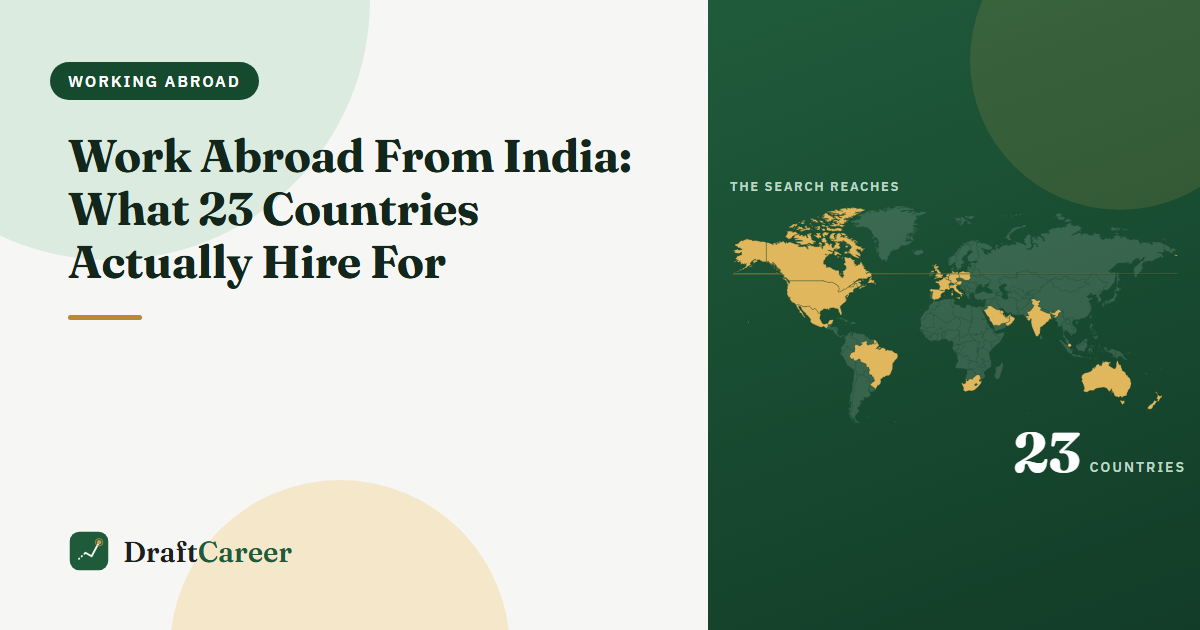
Most advice about working abroad is written backwards. It starts with the country - "top 10 countries for Indians" - when the question that actually decides the outcome is narrower and far more practical: which markets are currently short of people who do what you already do? A mechanical engineer with eight years in process plant work and a front-end developer with the same experience are looking at almost entirely different maps.
This is a country-by-country look at 23 markets where Indian professionals are hired, what each one tends to hire for, and what it pays in. It deliberately avoids two things you will find everywhere else: salary figures, which are meaningless without the role and the city attached, and confident claims about visa rules, which rot faster than anything else written on this subject.
On this page
The Gulf: where most Indians abroad actually are
The scale here is easy to underestimate. Indian mission estimates put roughly 8.75 million Indians across the six GCC countries - about 3.55 million in the UAE alone and 2.47 million in Saudi Arabia. In 2023-24 India received a record $118.7 billion in remittances, and the Gulf accounted for somewhere close to 38-40% of it, led by the UAE at about 19%.
The arithmetic that drives this is simple: none of these countries levies personal income tax. A salary that looks similar to an Indian one on paper does not stay similar after tax.
| Country | Pays in | Hiring concentrates in |
|---|---|---|
| United Arab Emirates | AED | Broadest of the five - construction, logistics, finance, healthcare, hospitality, technology. The largest Indian professional community anywhere outside India. |
| Saudi Arabia | SAR | Construction, healthcare and technology, hiring hard under the Vision 2030 programme. |
| Qatar | QAR | Energy, infrastructure and aviation. |
| Bahrain | BHD | Banking and financial services weigh unusually heavily in postings for a country this size. |
| Oman | OMR | Logistics, energy and tourism. |
One caution worth stating plainly. Gulf recruitment is heavily intermediated - far more of it runs through agents than hiring in Europe does - and the Ministry of External Affairs has issued repeated advisories about fake overseas job offers and about agents overcharging for them. The protection is boring and effective: deal with the employer directly wherever you can, and check any intermediary against the official register before money changes hands.
Europe: nine markets, and the routes built for outsiders
Europe is a different proposition from the Gulf. Pay is taxed, often heavily, but the roles are more likely to come with a path to staying long-term, and several countries have built routes specifically for qualified people arriving from outside the EU.
Germany is the one that has changed most. The Chancenkarte, or Opportunity Card, introduced a points-based route that lets qualified people enter the country to look for work without already holding a job offer - scored on qualification recognition, experience, German language ability and age, with a threshold of six points. It costs €75, runs for twelve months and permits part-time work while you search. The practical hurdle for most Indian applicants is not the points but whether their degree or vocational qualification is recognised in Germany, which is checked through the Anabin database before anything else. The two routes are compared in full in jobs in Germany for Indians, and how to use the government's Make it in Germany portal from India covers the official job listings.
The Netherlands runs a dedicated highly-skilled-migrant route, where the employer must be a recognised sponsor - which in practice narrows your search to companies already set up to hire from outside the EU. English is standard in Dutch technology and engineering roles.
| Country | Pays in | Worth knowing |
|---|---|---|
| United Kingdom | GBP | Skilled Worker visas are sponsored by the employer, so the job advert always comes first. Only licensed sponsors can hire you. |
| Germany | EUR | The Opportunity Card allows entry to job-hunt without an offer. Many technology postings are in English; most others are not. |
| Netherlands | EUR | Highly-skilled-migrant route via recognised sponsors. English is standard in tech and engineering. |
| France | EUR | A multi-year "Talent" residence route covers qualified hires. French helps and is often expected outside tech. |
| Spain | EUR | Growing engineering and shared-services hiring around Madrid and Barcelona. |
| Italy | EUR | Manufacturing, design and engineering, concentrated in the north. |
| Austria | EUR | The Red-White-Red Card is scored on qualifications and experience. |
| Belgium | EUR | EU institutions and pharmaceuticals alongside a large logistics sector. |
| Poland | PLN | One of Europe's fastest-growing destinations for IT and shared-services work. |
The rest of the world
| Country | Pays in | Worth knowing |
|---|---|---|
| United States | USD | Employer sponsorship and the H-1B cap make securing the offer the whole battle. |
| Canada | CAD | Express Entry scores applicants on age, education, language and experience. Bonus points for a job offer were removed in March 2025 - check the current rules rather than older guides. |
| Australia | AUD | Employer sponsorship runs through the Skills in Demand visa, which replaced the TSS visa in December 2024, against a published occupation list. |
| New Zealand | NZD | The Green List fast-tracks shortage occupations, many of them technical. |
| Singapore | SGD | Employment Pass eligibility is set by salary and qualifications, and the thresholds have risen repeatedly. |
| South Africa | ZAR | Critical skills lists cover engineering, health and IT roles. |
| Brazil | BRL | The largest market in Latin America. Portuguese is expected in most roles. |
| Mexico | MXN | Manufacturing and nearshore services, concentrated around Monterrey and Mexico City. |
| India | INR | Worth searching alongside the rest, so an offer at home can be compared against one abroad on the same screen. |
What this costs, and what an agent may legally charge
This is the part most articles leave out, and it is the part that costs people real money.
Under India's Emigration Act, 1983, a registered recruiting agent may lawfully charge you a service charge of ₹30,000 plus 18% GST - about ₹35,400 - and no more. The Ministry of External Affairs publishes the list of registered agents at emigrate.gov.in.
The MEA's own advisory on overseas recruitment states that overcharging by unregistered agents commonly runs to ₹2-5 lakh. That is the gap worth understanding before you pay anybody: not a slightly worse deal, but five to fifteen times the legal ceiling, frequently for a job that does not exist.
You do not need an agent at all for the large majority of these roles. Employers who are licensed to sponsor foreign hires advertise publicly, because that is how sponsorship works - the job has to be visible. Searching those adverts directly and applying yourself costs nothing but the time.
The mistake almost everyone makes
Most people applying abroad send the same resume to every country, with the company name changed.
A Dutch engineering firm and a Riyadh contractor are not reading for the same things. Conventions differ - length, whether a photo is expected, how much personal detail belongs on the page - and so does the vocabulary. A posting written in Gulf hiring language and one written by a German Mittelstand manufacturer describe overlapping work in entirely different words, and an applicant tracking system matching keywords does not know they are synonyms.
The resume that works for one reads as careless to the other. Sending one document to twenty countries is not efficiency; it is twenty weak applications instead of five strong ones. Our guide to tailoring a resume to a job description covers the mechanics, and resume formats around the world covers what changes by market.
Where to start
Three steps, in this order:
- Find out which markets are advertising your occupation right now. Not which country sounds best - which ones currently have open roles matching what you already do. That one search eliminates most of the map and saves months.
- Check the route before you invest in the application. Sponsorship, recognition of your qualification, language level. Use the country's official immigration site, not a blog, and not an agent's sales pitch.
- Write the application for the posting. One resume rewritten against each advert, and a cover letter drawn from that advert's own wording.
DraftCareer searches live openings across all 23 of the countries in this article, and rewrites your resume and cover letter for whichever posting you choose. You apply to the employer yourself, directly - we are not a recruitment agent, we take no commission, and we never handle your documents. You can build a profile and run the search free before paying for anything, and compare all 23 countries on tax, diaspora size and what happens if you lose the job.
One necessary caveat
Nothing here is immigration advice. Visa routes, salary thresholds and occupation lists change frequently - the Canadian example above changed in the middle of 2025, and Australia's visa was replaced in December 2024 - and the only reliable source for any of it is the official immigration authority of the country you are applying to. Use this article to narrow the map, then verify before you commit money or a decision to it.