A resume that lands an interview in Chicago can look completely wrong in Berlin, London, or Tokyo. That's not because one country has a "better" format — it's because each region built its own conventions around different labor laws, hiring cultures, and ideas about what employers are even allowed to ask. If you're applying internationally, or just curious how job hunting differs outside your own market, here's an honest look at four of the most distinct approaches: the US resume, the EU's Europass CV, the UK CV, and Japan's rirekisho.
The US Resume: Built for Speed and Screening
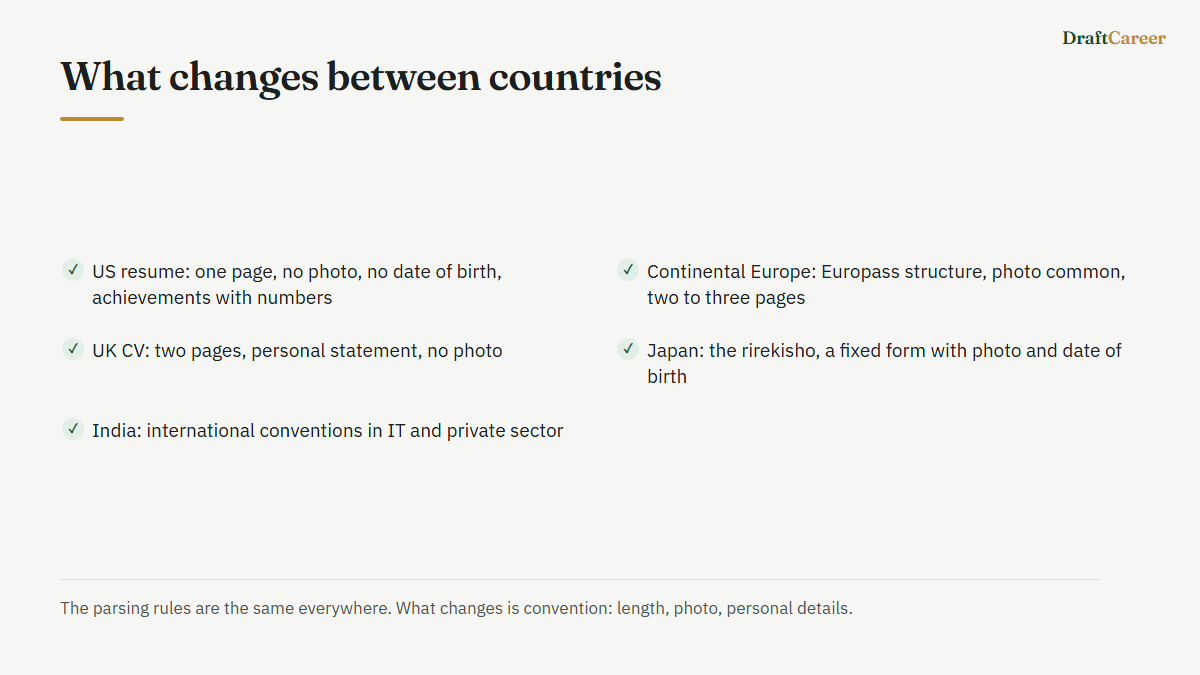
The American resume is optimized for two audiences that read it in very different ways: software and humans. Applicant tracking systems scan for keywords and clean structure before a recruiter ever sees the document, which is why the modern US convention favors a single column, standard section headings ("Experience," "Education," "Skills"), and plain fonts rather than tables, graphics, or multi-column layouts that can confuse a parser.
On length, the old "must fit on one page" rule has loosened. Plenty of current career guidance points out that resumes now commonly run to a page and a half or two pages for people with substantial experience, with one page still the norm for early-career candidates. What hasn't loosened is the exclusion of personal information: US resumes omit a photo, date of birth, marital status, and nationality almost without exception. This isn't a stylistic preference — it's a direct response to anti-discrimination law. Employers are wary of receiving information that could expose them to bias claims before a candidate is even interviewed, so most large US employers will reject a resume that includes a photo outright.
The content itself tends to be achievement-focused: bullet points built around quantified outcomes ("reduced processing time by 30%") rather than a narrative description of duties. Tailoring language to match the exact terms in a job posting also matters more than it might seem, since ATS software often looks for literal keyword matches rather than close synonyms.
Europass and Continental Europe: A Standard Form, With National Variations Underneath
The EU publishes the format itself: Europass offers a free online editor and a standard structure that public-sector employers across member states recognize immediately.
The European Union addressed the "every country does it differently" problem by creating Europass — a free, standardized CV template available at europass.europa.eu that's recognized across all EU member states plus a handful of neighboring countries. It presents personal details, work experience, education, and language ability in a fixed order, and it leans on the Common European Framework of Reference (CEFR) to describe language skills in a way that means the same thing whether an employer is reading it in Warsaw or Lisbon. Europass CVs also commonly include a photo field, which already signals a real divergence from US and UK norms.
Europass is genuinely useful for EU institutions, universities, research positions, and cross-border government roles, where a recognizable common format matters. But it's worth knowing that most private-sector employers in Europe don't actually require it — many prefer a more customized CV, and conventions vary noticeably by country even outside the Europass template. Germany's Lebenslauf, for instance, traditionally includes a professional headshot in the top corner of the page along with date and place of birth, nationality, and sometimes marital status, with dates written in day-month-year format. That said, an increasing number of international companies, startups, and firms with US or UK ownership now run anonymized hiring processes and explicitly ask candidates to leave the photo and personal details off. France follows a broadly similar pattern to Germany — a photo and sometimes a date of birth are still common — but French CVs are typically kept to one page even for experienced candidates, with two pages reserved for senior roles with a decade or more of experience.
The throughline across continental Europe is that personal information which would be legally risky to request in the US or UK — birth date, photo, nationality — has traditionally been normal to include, though that norm is visibly shifting as more companies adopt anglophone-style anonymized screening.
The UK CV: A Close Cousin With Real Differences
A UK CV looks similar to a US resume at a glance — reverse-chronological work history, no decorative graphics, a professional tone — but the details diverge in ways that trip up American applicants. UK CVs are conventionally two pages rather than one, printed or exported on A4 paper instead of US letter size. They almost always open with a short personal statement, typically three to five lines summarizing who the candidate is and what role they're seeking, which plays a similar role to the "professional summary" that's become more common on US resumes in recent years but is treated as close to mandatory in the UK.
Photos are excluded from UK CVs for the same anti-discrimination reasoning as in the US. Where things get more nuanced is personal information: guidance on this has genuinely shifted over time, and while older UK CVs sometimes included date of birth or marital status, that practice is declining as UK employers apply stricter anti-discrimination and data-privacy standards, so the safer modern default is to leave it out unless specifically asked. Spelling and dating conventions are the other giveaway — British English spelling (organization, color, realise) and day/month/year date formatting, rather than the US month/day/year convention.
Japan's Rirekisho: The Most Structurally Different Format on This List
Nothing on this list resembles the freeform, achievement-led US resume less than Japan's rirekisho (履歴書). It isn't a loose stylistic tradition — it's a genuinely rigid document. The rirekisho follows a fixed, standardized layout: sections for name, address, education history, work history, licenses and qualifications, and a dedicated "reason for applying" (志望動機, shibou douki) field are all present in a set order, with little to no room for the kind of free-text narrative a Western resume relies on. Many companies specifically request the JIS (Japanese Industrial Standard) format, one of the most common standardized templates in use. It's also worth noting that the older JIS template's mandatory gender and marital-status fields were withdrawn as a standard element in 2020, and updated forms increasingly make fields like gender optional.
A photo is mandatory, not optional, and it follows a specific convention: a formal headshot roughly 3x4 centimeters, taken from the chest up against a plain white, light blue, or light gray background. The document itself is conventionally printed on A4 paper as a two-page form, though the traditional version was printed on a single folded A3 sheet that opens like a booklet. On the question of handwriting versus typing — a detail many outside guides get vague about — the honest current answer is that typed rirekisho are now the norm and are perfectly acceptable at most companies, especially larger and more international ones, but some traditional industries (banking, manufacturing, government, and some smaller employers in hospitality and care work) still view handwriting the form by hand as a signal of sincerity and attention to detail. When in doubt, sending a clean typed version is generally treated as safer than a handwritten one with mistakes.
Crucially, the rirekisho is usually only half the picture for experienced professionals. Japan's hiring system commonly pairs it with a second document, the shokumu keirekisho (職務経歴書) — a much more flexible, Western-CV-like document where a candidate describes their actual work history, responsibilities, and contributions in their own words. The rirekisho establishes verified facts; the shokumu keirekisho makes the case for why those facts matter. First-time job seekers straight out of school typically only need the rirekisho, while mid-career applicants are expected to submit both.
The four formats, side by side
| US resume | Europass / continental CV | UK CV | Japanese rirekisho | |
|---|---|---|---|---|
| Length | 1 page, 2 with experience | 2–3 pages | 2 pages | Fixed form, 1–2 pages |
| Photo | Never | Common in Germany, France, Spain | No | Required, to a set size |
| Date of birth | Never | Often expected | No | Required |
| Structure | Free-form, tailored per role | Standardized sections | Free-form, with a personal statement | Prescribed grid, filled in the same order by everyone |
| Tone | Achievements and numbers | Qualifications and duties | Achievements, more understated | Facts only; motivation goes in a separate document |
| Tailored per application | Always | Sometimes | Usually | No — the form is the form |
Applying in more than one country?
Keep one profile and switch templates per market — photo or no photo, one page or two — instead of maintaining separate files that drift apart. DraftCareer has 48+ templates, three of them free.
Why Resume Formats Around the World Differ at All
None of these formats is objectively "correct" — each reflects what a given hiring system considers fair, efficient, or trustworthy. Personal details that read as a privacy risk to a US employer read as normal transparency to a German one. A one-page limit that signals conciseness in the US would read as strangely sparse against a UK CV's expected personal statement. And a completely freeform US-style resume submitted where a JIS-format rirekisho is expected can genuinely read as a mismatch, not just a stylistic choice.
If you're building out a resume for the US or similar Western, ATS-driven hiring markets, a clean, ATS-safe, single-column template is the safest general-purpose choice — which is the kind of format most resume builders, including DraftCareer's own templates, are designed around. But if you're applying somewhere with a genuinely different convention, the format itself is part of the application. Doing a little homework on what's actually expected — rather than assuming your home country's norms travel everywhere — is worth the extra ten minutes.