Make it in Germany is the German government's own website. It is free, it is run by the Federal Government rather than by any recruiter, and it has been the official portal for qualified professionals from abroad since November 2018. We are not it, we are not affiliated with it, and if you came here looking for it, the portal is here.
That matters more than it might sound. Indian professionals looking for work abroad are a heavily targeted group - the Ministry of External Affairs issues advisories about fake overseas job offers often enough that it maintains a register of lawful agents - and "official German government job portal" is exactly the phrase someone would misuse. Nobody should ever charge you to access it, to register on it, or to "unlock" its listings.
So this post does not try to replace the portal. It answers the thing the portal does not: what its listings quietly assume you already have, and what to do once you have a shortlist.
On this page
What the portal actually is
Three things at once, which is part of why people find it confusing.
It is a visa and immigration guide, and this is the part it does best. The rules for skilled migration to Germany changed substantially under the Skilled Immigration Act, and the portal is the authoritative plain-language explanation of where they stand now.
It is a job board, listing vacancies from employers who have specifically agreed to receive applications from skilled workers living abroad. That agreement is the useful filter. A German employer who has not thought about international hiring will often not reply to an application from India at all - not out of prejudice, but because sponsoring is work they have not set up to do.
And it is a settling-in guide, covering recognition of qualifications, bringing family, and what happens after you arrive.
What it is not is an application service. You find the employer through it and apply to the employer. There is no intermediary in that chain and no fee anywhere in it.
What the job listings assume about you
This is the gap worth naming, because it is where most people stall.
The portal's listings are aimed at skilled workers in the specific German legal sense - someone with either a recognised university degree or a recognised vocational qualification of at least two years. "Recognised" is doing enormous work in that sentence. It does not mean your degree is good. It means a German authority has assessed it as equivalent to a German one.
So before browsing listings at all, the useful question is: where does my qualification stand in Germany? There are three answers and they lead to different places.
- Fully recognised. The straightforward path. The portal's listings are aimed squarely at you, and a job-first route - apply, get offered, employer sponsors the permit - is the normal sequence.
- Partially recognised. Not a dead end, and this is the case Germany has built policy around. Partial recognition is worth points on the Opportunity Card.
- Not assessed yet. Start here rather than with job listings. Everything else follows from it.
The second assumption is quieter: the listings expect an application that engages with the specific advert. German job postings tend to be longer and more precise than Indian ones, listing requirements in a way that reads almost like a checklist. That is not bureaucratic padding. It is an invitation to answer it point by point, and an application that ignores it reads as an application that was sent to forty other employers too.
Where the Opportunity Card fits
The Opportunity Card (Chancenkarte) has been in force since 1 June 2024, and it is the reason Germany is worth more attention from Indian applicants than most of Europe.
Almost every skilled route into Europe requires the job offer first. The Opportunity Card runs the other way: it is a residence permit for looking. You qualify either by holding a fully recognised qualification, or by scoring at least six points on a test that counts partial recognition, language ability, work experience, age, previous legal stay in Germany, and whether your occupation is one Germany is formally short of.
The minimum language requirement is German at A1 or English at B2 - one or the other. It is normally issued for a year, and while you hold it you may work part-time up to 20 hours a week and take trial employment of up to two weeks with an employer considering you.
You also have to show you can support yourself while you look, usually through a blocked account or a part-time contract. That figure is reset annually - it was around €1,091 a month for 2026 - so check the current number with the Federal Foreign Office rather than with any blog post, this one included.
The full comparison with the Job Seeker Visa, including which one you are likely to be eligible for, is on our jobs in Germany for Indians page.
The language question, answered properly
People ask whether they need German and get told "it depends", which helps nobody. It depends on two separate things and they have different answers.
For the visa: no. English at B2 satisfies the Opportunity Card's language minimum on its own.
For getting hired: it depends entirely on the sector, and the gap is wide. A large share of technology, engineering and shared-services roles in Germany are advertised, interviewed and worked in English. Most roles outside those are not.
The practical rule needs no judgement at all: apply in the language the advert is written in. If the posting is in German, an English application tells the employer you did not read it. If the posting is in English, German is not required to apply, and claiming fluency you do not have will surface in the first interview.
What to do with a shortlist
Say the portal has given you eight roles you plausibly match. This is the point where most applications are lost, and it is nothing to do with visas.
Eight applications sent with one resume produce eight silences. German hiring reads a CV against the advert more closely than most markets do, and those long, specific job descriptions are the thing you are supposed to answer. A resume that was written for your last job and not for this posting answers none of it.
So the work after the shortlist is: for each role, a resume that uses the advert's own terms for the things you have actually done, and a cover letter that addresses its stated requirements rather than restating your CV in prose. It is slow by hand. It is the entire difference between eight silences and a reply.
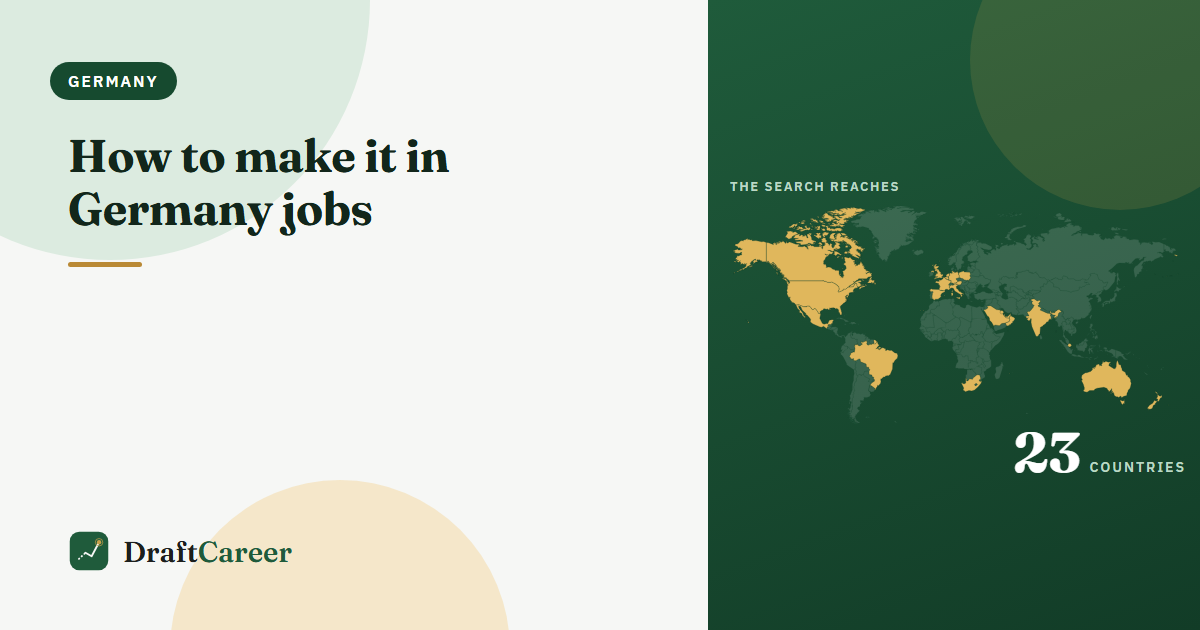
That is the part DraftCareer does. We search openings that are already public across Germany and 22 other countries, and write the resume and cover letter for the posting you choose. You apply yourself, directly to the employer. We do not place you, we do not sponsor visas, we charge no commission, and we are not a recruitment agent - for the German listings themselves, the government's own free portal is where you should start.
Weighing Germany against other countries? How to work abroad from India compares the Gulf, Europe and the rest, and the Germany page sets out the two entry routes side by side.