"Nobody reads cover letters anymore" shows up in almost every job-search thread, usually stated as settled fact. It isn't quite settled, and it isn't quite fact — it's a real pattern at one end of the hiring spectrum, generalized to cover every application, which is where it stops being reliable advice.
Where the claim comes from
At large companies running high-volume postings — hundreds of applicants for one role, an ATS doing the first pass — a cover letter genuinely does go unread a meaningful share of the time. Many of those application portals mark the field "optional," most applicants skip it, and a recruiter moving through a long ranked list often doesn't open every attachment for every candidate. If your entire frame of reference is applying to large companies through their careers portal, "nobody reads it" can feel like lived experience, because in that specific context, it often is.
Where it clearly isn't true
It is worth remembering what the document is for. A cover letter exists to say the things a resume structurally cannot, and career offices such as MIT's still teach it for exactly those cases.
That pattern doesn't hold everywhere. A few situations where a cover letter still reliably gets read, and matters:
- Smaller companies and startups, where a founder or hiring manager is personally reading applications rather than delegating the first pass to a system.
- Applications that came through a referral or a warm introduction — the person reading it already has a reason to look closely.
- Roles where writing itself is part of the job — marketing, communications, content, anything where a poorly written cover letter is itself disqualifying evidence.
- Career changes or explaining a gap, where a resume alone can't carry context that only prose can — why the pivot, what transfers, what doesn't need to be guessed at.
In each of these, skipping the letter doesn't just fail to help — it removes the one place you could have addressed the question a reader is already asking themselves.
If the answer is "write one", make it quick.
DraftCareer drafts a cover letter from your profile and the job post, so a letter worth sending costs you minutes rather than an evening. The manual version takes ten minutes if you'd rather write it yourself.
Is a cover letter worth the time? The actual cost-benefit
A short, well-structured cover letter takes roughly fifteen to twenty minutes once you have a template for the shape of it — four short paragraphs, no throat-clearing opener. Against that modest cost, the downside of skipping one is asymmetric: in the contexts above, not writing one can quietly cost you a look you'd have otherwise gotten, while writing one in a context where it truly goes unread rarely costs you anything at all. A cover letter that goes unopened doesn't count against you. One that was expected and missing sometimes does.
When it's genuinely fine to skip
The claim isn't wrong everywhere — there's a real category where skipping is a defensible, low-risk call: the field is marked optional, you're applying to a large organization through its standard portal, and you have no specific reason (referral, career pivot, direct founder contact) that a letter would actually address. In that narrow case, spending the time tailoring your resume to the posting is very likely the better use of the same fifteen minutes.
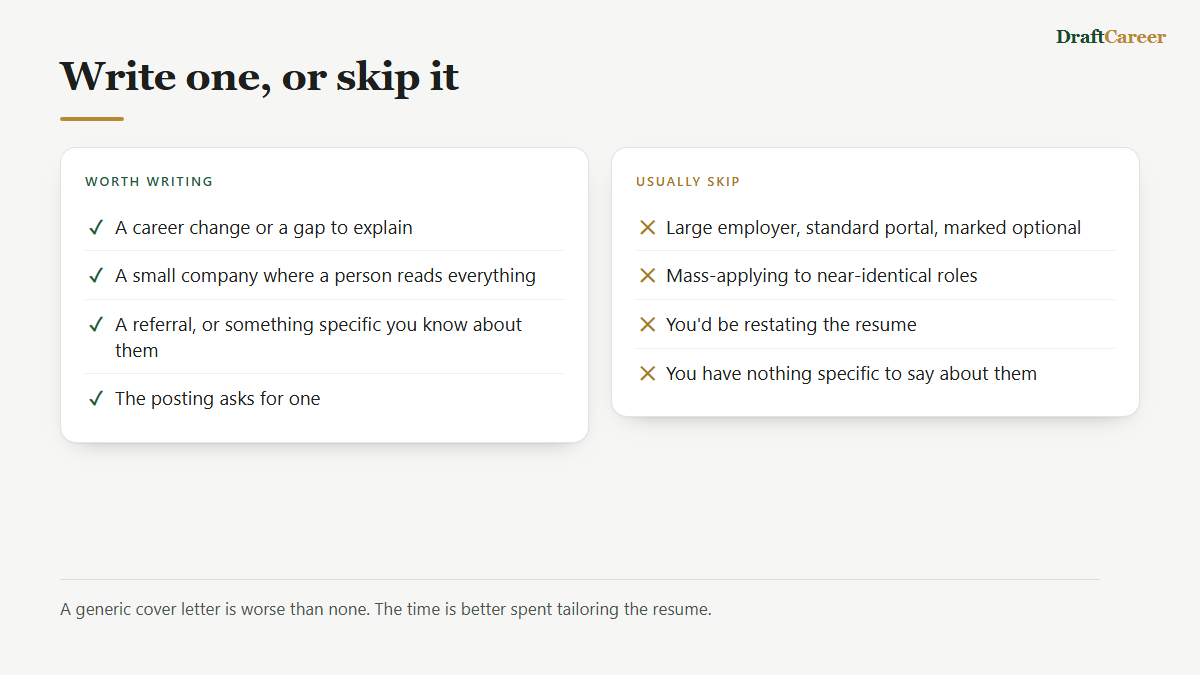
Write one, or skip it
| Situation | Worth writing? | Why |
|---|---|---|
| Career change, or a gap that needs context | Yes | It is the only place the resume's story can be explained |
| Small company, founder or manager reads applications | Yes | A human reads everything; the letter is read too |
| A referral, or you know something specific about them | Yes | Names and specifics travel further than any resume line |
| The posting asks for one | Yes | Not sending one is a filter you fail for free |
| Large employer, standard portal, marked optional | Often skip | The same time spent tailoring the resume does more |
| Mass-applying to near-identical roles | Skip | A generic letter is worse than none |
The short version
"Cover letters are dead" is a real pattern at the high-volume end of hiring, generalized past where it holds. Smaller companies, referrals, writing-adjacent roles, and career pivots are all places where a letter still gets read and still matters. When in doubt and the field isn't marked required, the fifteen minutes it takes is cheap insurance against the one context where skipping it does cost you. DraftCareer's cover letter tool drafts a starting version from your profile and a pasted job description, so writing one doesn't have to start from a blank page.