Most cover letters get skimmed, not read. A hiring manager or recruiter is usually moving fast, and a cover letter that opens with a stock line and then repeats the resume underneath it gives them no reason to slow down. The good news is that a cover letter which actually earns attention isn't longer or more elaborate — it's just more specific. This guide covers the structure, the opening, and the mistakes worth avoiding.
What a cover letter is actually for
Your resume lists what you've done. A cover letter's job is to explain why it matters for this particular role, at this particular company. It's the one part of your application where you get to connect the dots yourself instead of hoping the reader connects them for you. If a cover letter doesn't do that — if it just restates your job titles in sentence form — it isn't adding anything, and the reader will notice.
How to write a cover letter: the structure that works
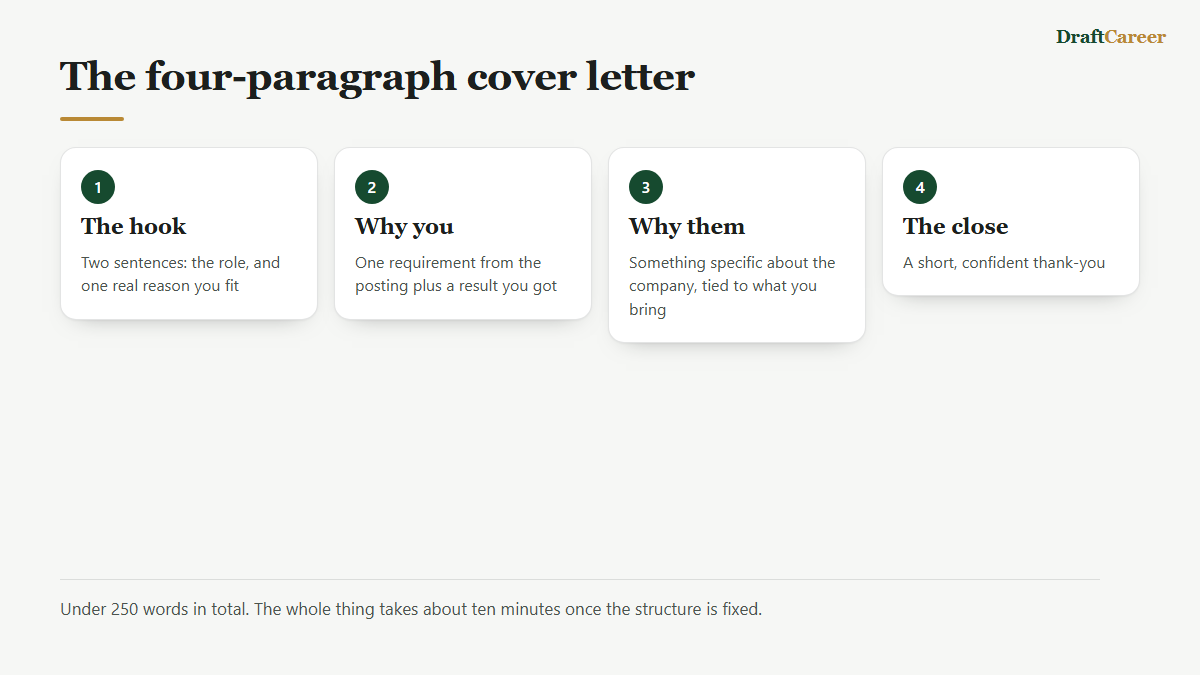
A cover letter doesn't need an elaborate shape. Four short paragraphs cover almost every case:
- Opening: one or two sentences that state what you bring or why this specific role caught your attention — not a throat-clearing announcement that you're applying.
- Relevant proof: one or two examples from your background, chosen because they map onto what the role actually needs, not because they're your proudest achievements in general.
- Why this company: a short, specific reason you want this job at this organization — something that couldn't be copy-pasted into a letter for a competitor.
- Close: a brief, confident sign-off that says what you'd like to happen next.
That's it. There's no rule requiring an "introduction paragraph" that just restates the job title, and there's no benefit to a fifth or sixth paragraph unless the role genuinely calls for more context (a career change, a gap, a referral worth naming).
The opening line: skip the announcement
The most common way to waste the first sentence is to spend it announcing what the reader already knows: that you are applying, and for what. "I am writing to apply for the position of X, as advertised on your careers page" tells the reader nothing they don't already know from the subject line. It also sounds identical to every other letter in the pile.
A stronger opening does one of two things: it leads with a concrete, relevant fact about you, or it shows you understand something specific about the role or company. Compare:
Weak: "I am writing to apply for the Marketing Coordinator position at your company. I believe I would be a good fit for this role."
Stronger: "I've spent the last three years building lifecycle email campaigns for a subscription business, and your job post's focus on retention over acquisition is exactly the kind of problem I want to keep solving."
The second version is longer but it isn't slower to read — it front-loads something useful. It tells the reader what you do, signals you actually read the posting, and gives them a reason to keep going. Neither example above is lifted from a real letter; they're just illustrations of the same information handled two different ways.
Connecting your background to the job, not repeating it
This is where most cover letters go wrong. It's tempting to treat the letter as a second copy of the resume in paragraph form — "In my last role, I managed a team of five and increased sales by 20%." If that line is already on your resume, restating it here adds nothing.
What's missing from most letters is the "so what." Instead of restating an achievement, use the space to explain why it's relevant to this job specifically:
Instead of: "I managed a team of five and increased regional sales by 20% over two years."
Try: "Growing that regional team taught me that most sales slumps are a coaching problem, not a pipeline problem — which is why your posting's emphasis on rep development, rather than just headcount, stood out to me."
The second version keeps the same underlying fact but uses it to make an argument about fit. That's the actual function of a cover letter: pick one or two things from your background, and use them to make a case, rather than listing everything you've done and hoping the reader draws the same conclusion you would.
This also means a cover letter should change for every application. If you can swap out the company name and job title and the letter still reads fine, it isn't tailored — it's just personalized. Tailoring means the substance of the middle paragraph would actually need to change for a different role, because it's built around what that specific posting asked for.
Length: shorter than you think
A cover letter that runs long is usually a sign it hasn't been edited, not a sign of extra effort. Across current hiring guidance, the range that keeps coming up is roughly 250 to 400 words — about three to four short paragraphs, fitting comfortably on half a page. Some hiring-manager surveys suggest a large share of readers spend well under two minutes on a cover letter, and a meaningful portion skim it in under thirty seconds. Anything that requires scrolling on a screen is probably asking too much of that attention span.
If you're cutting for length, cut the padding first: throat-clearing openers, restated job descriptions, and any sentence that would apply equally to any candidate for any job.
Mistakes worth double-checking
- Generic letters. A letter that never mentions anything specific to the role or company reads as a template, because it is one.
- Resume repetition. If a line only restates a bullet point from your resume without adding context or reasoning, cut it.
- Focusing on what you want. A letter heavy on "this role would help me grow" and light on what you'd contribute reads as self-focused. Employers are reading to answer one question: what would you do for them.
- Typos and careless errors. Several hiring-manager surveys report that a single typo is enough to knock a candidate out of consideration for a meaningful share of employers. It's a small thing to fix and a disproportionately costly thing to miss — proofread, and ideally have someone else read it too.
- An opening that says nothing. As covered above, this is the single most common miss, and the easiest to fix once you notice it.
Ten minutes, not an evening.
DraftCareer drafts a cover letter from your profile and the job description, in your own wording, then lets you edit every line. Prefer to write it yourself? Our four-paragraph formula has a fill-in-the-blank template.
The short version
Open with something specific instead of an announcement. Use the middle of the letter to connect one or two parts of your background to what this particular role needs, rather than repeating your resume. Say something real about why this company, not just this job. Keep the whole thing under half a page. None of this requires cleverness — it just requires writing every line as if a specific person is going to read it, because one is.