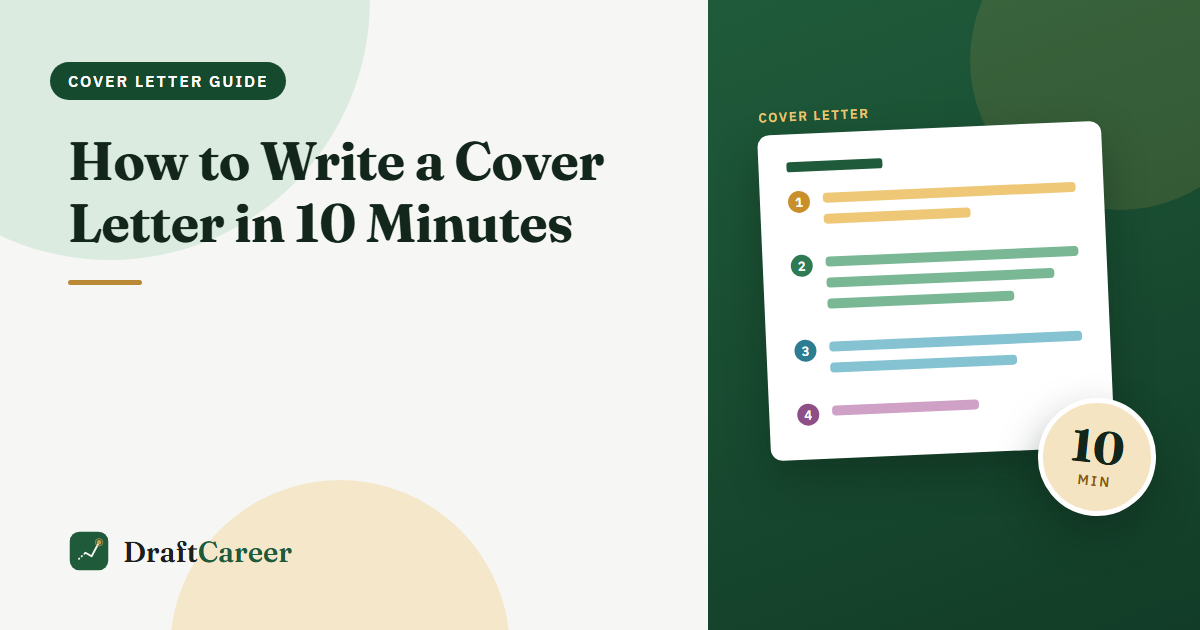
Most people either skip the cover letter or spend an hour agonizing over it. Both are mistakes. A short, specific cover letter can still tip close decisions in your favor — and with a repeatable structure, you can write one in about ten minutes. Here's the formula, then a template you can copy.
Why bother with a cover letter in 2026?
Plenty of applications mark it "optional." But when two candidates look similar on paper, a sharp, tailored letter that shows you understand the role can be the tiebreaker. (We dig into when it matters most in is a cover letter still worth writing in 2026?) The trick is to make it short (under 250 words), specific to the job, and about them — not a reworded version of your resume.
The 4-paragraph formula
- The hook (2 sentences). Say what role you're applying for and one genuine reason you're a strong fit or excited about the company. Skip "I am writing to apply for…" — that's a wasted opening.
- Why you (3–4 sentences). Pick the one or two requirements from the job description that you match best, and give a concrete proof point with a result. This is the heart of the letter. If you're not sure which requirements matter most, pull the keywords from the posting first.
- Why them (2–3 sentences). Show you actually know the company — a product, value, or recent move you like — and connect it to what you'd bring.
- The close (1–2 sentences). A confident, low-pressure sign-off and a thank-you.
Fill-in-the-blank template
Here's the formula as a letter you can copy. Switch to the filled-in example to see the same four paragraphs with real details — the colours match the formula above.
Dear [Hiring Manager name — find it on LinkedIn; "Hiring Team" only if you truly can't],
1 · The hookI'm applying for the [Job Title] role at [Company], and [one specific reason — e.g., "your work on X is exactly the kind of problem I love solving"].
2 · Why youIn my time at [Company/School], I [accomplishment with a number — e.g., "grew email revenue 30% by rebuilding the onboarding sequence"], which maps directly to [the key requirement from the posting]. I also [second relevant proof point].
3 · Why themWhat draws me to [Company] specifically is [genuine, specific reason — a product, value, or direction]. I'd love to bring [your relevant strength] to your team.
4 · The closeThank you for your time — I'd welcome the chance to talk.
[Your name]
Dear Priya Shah,
1 · The hookI'm applying for the Content Marketing Manager role at Brightwave, and your "learn in public" newsletter is exactly the kind of audience-first writing I love building.
2 · Why youIn three years at Northwind Health, I grew organic newsletter signups 42% by rebuilding our editorial calendar around search data, which maps directly to your need for someone who can own content strategy end to end. I also launched a customer-story series that brought in 180 demo requests in its first quarter.
3 · Why themWhat draws me to Brightwave specifically is how openly you share product decisions with your users — it's rare, and it builds real trust. I'd love to bring that same audience-first approach to your content team.
4 · The closeThank you for your time — I'd welcome the chance to talk.
Alex Morgan
Four paragraphs, one job each. Hook them, prove the match, show you know the company, and get out of the way.
Common cover-letter mistakes to avoid
- Restating your resume. Add context and personality, don't repeat bullets.
- Being generic. "I'm a hard worker and team player" says nothing. Specifics win.
- Making it about you only. Balance "why me" with "why them."
- Going long. Under 250 words. Hiring managers skim.
- Forgetting to change the company name. The classic — proofread every time.
Do it faster (and never send the wrong company name)
The slow part is customizing for each job. This is where a tool helps: paste the job description and generate a tailored first draft, then edit it in your own voice. On paid plans, DraftCareer drafts a matched cover letter alongside your resume when you paste a job posting, so you start from something specific instead of a blank page — just always read it over and make it sound like you before you send. (Whatever you use, the 4-paragraph formula above is what makes it land.)